
Crumbl Franchise Brand Brief: Growth Slows as Average Sales Fall and Profit Disclosure Disappears
Brand: Crumbl
Industry: Cookies and Specialty Desserts
FDDs Reviewed: 2025 and 2026
Relevant FDD Topics: Items 3, 6, 7, 8, 12, 19, 20 and 21
Overall Risk Signal: 🔴 Red
Primary Concern: Declining average unit sales, reduced financial transparency and the franchisor’s disclosed financial condition
This Franchise Brand Brief is for educational and informational purposes only. It is not legal, financial or investment advice. The risk signals, commentary and conclusions expressed herein represent the opinions of the author based on the information reviewed. Prospective franchisees should independently verify all information and consult qualified legal, financial and other professional advisors before investing.
Why This Report Matters
Crumbl is one of the most recognizable franchise success stories of the past decade. Its rotating menu, distinctive pink packaging and enormous social media presence helped the brand grow from 326 franchised locations at the beginning of 2022 to more than 1,100 by the end of 2025.
But brand visibility and franchise performance are not the same thing.
The 2026 Franchise Disclosure Document reveals a system that is still growing, but at a dramatically slower pace. Average and median store sales declined substantially in 2025. Transfers increased. The franchisor removed the gross profit and net profit figures it had disclosed one year earlier. Most notably, the FDD now includes a special risk warning stating that the franchisor’s financial condition calls into question its ability to provide services and support to franchisees.
For buyers evaluating Crumbl today, the important story is no longer how quickly the brand grew. It is what the economics and support structure look like after that rapid expansion.
🔴 Average Store Sales Fell Nearly 16%
The most important year-over-year change appears in Item 19.
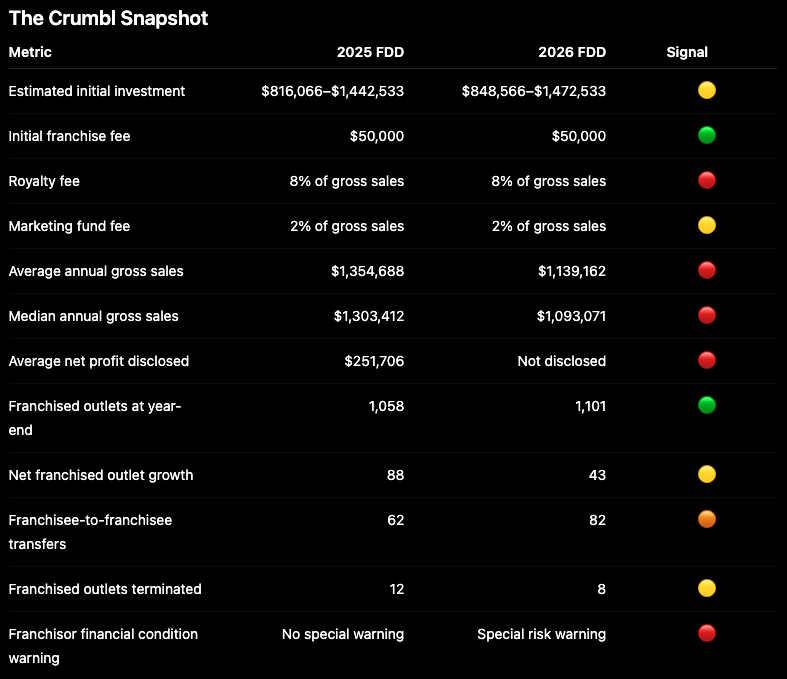
The 2025 FDD reported average 2024 gross sales of $1,354,688 across 858 reporting locations. Median gross sales were $1,303,412.
The 2026 FDD reports average 2025 gross sales of $1,139,162 across 776 reporting locations. Median gross sales fell to $1,093,071.
That represents a decline of approximately 15.9% in average gross sales and 16.1% in median gross sales in a single year.
The top-performing store also declined slightly, from $3.48 million to $3.42 million. At the lower end, the lowest reporting store generated $365,129 in annual gross sales, down from $383,711 in the previous disclosure.
These figures do not establish what any individual franchisee will earn, and the reporting groups are not identical. Nevertheless, the decline is broad enough to warrant careful investigation, especially for a concept requiring an estimated investment that can exceed $1.4 million.
Signal: 🔴 Red
🔴 Crumbl Removed Its Profit Disclosure
The sales decline is significant. The change in what Crumbl chose to disclose may be just as important.
In its 2025 FDD, Crumbl provided average and median figures for gross sales, gross profit and net profit. The company reported:
Average gross profit of $653,586
Median gross profit of $617,709
Average net profit of $251,706
Median net profit of $223,236
In the 2026 FDD, those gross profit and net profit figures are gone. The current Item 19 reports gross sales only.
As a result, prospective buyers can see that average store revenue fell by more than $215,000, but they cannot use the current FDD to determine how labor, food costs and other operating expenses affected store-level profitability during the same period.
The removal does not prove that stores became unprofitable. It does, however, eliminate one of the most useful financial disclosures available to prospective buyers precisely when unit revenue has declined.
The reporting pool also became smaller. The 2025 representation included financial information from approximately 81% of the eligible locations identified in the disclosure. The 2026 representation includes approximately 74% of locations that operated continuously throughout 2025. Eight stores that closed during 2025 are excluded from the current Item 19 data.
Signal: 🔴 Red
🟡 The System Is Still Growing, but Growth Has Slowed Dramatically
Crumbl ended 2025 with 1,101 franchised outlets, up from 1,058 at the end of 2024. On its face, that remains positive growth.
The pace, however, has changed sharply:
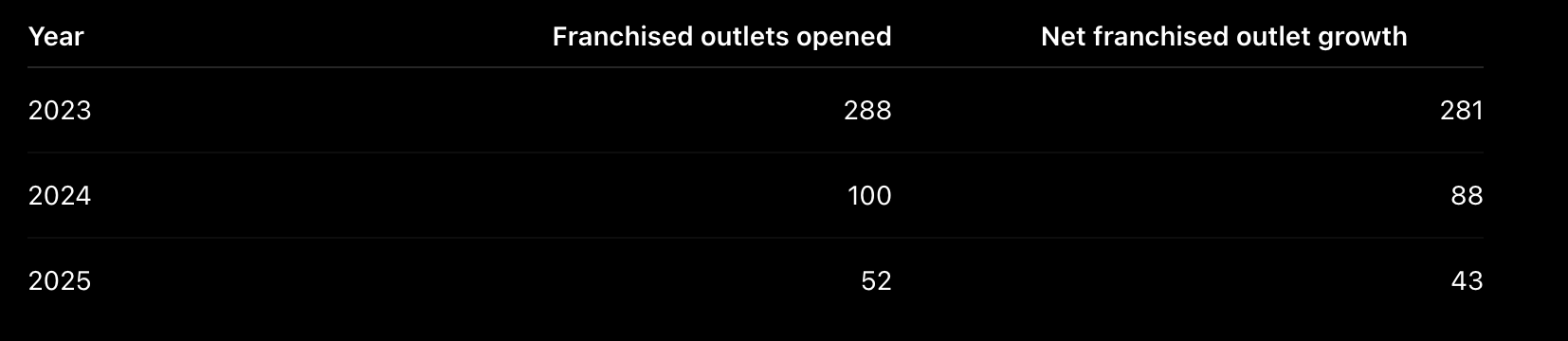
New store openings fell from 288 in 2023 to 100 in 2024 and then to 52 in 2025. Net growth fell from 281 locations to 88 and then to 43.
Crumbl is not currently reporting a contracting domestic franchise system. But this is no longer the hypergrowth story buyers may associate with the brand. It appears to be transitioning into a more mature and potentially more saturated phase.
The 2026 FDD identifies 207 signed franchise agreements for outlets that had not yet opened and projects 98 new franchised outlets during the following fiscal year. Buyers should investigate how many of those agreements are progressing toward opening, where the remaining development opportunities are located and whether delays are affecting existing franchisees or new operators.
The FDD specifically lists unopened franchises as a special risk, warning that a significant number of agreements have been signed for stores that have not yet opened.
Signal: 🟡 Yellow
🟠 Transfers Increased as New Openings Declined
Transfers between franchisees increased from 44 in 2023 to 62 in 2024 and 82 in 2025.
A transfer does not necessarily mean a failed store. Franchisees sell for many reasons, and a successful resale can be a healthy part of a mature system. But increasing transfers become more important when they occur alongside declining average sales and slowing new-unit growth.
In 2025, Crumbl reported 82 transfers compared with only 52 new franchised outlet openings. In other words, considerably more locations changed hands than opened during the year.
Prospective buyers should speak with both current operators and franchisees who recently sold. The most useful questions concern sale prices, time on the market, outstanding debt, required reinvestment and whether sellers recovered their original investment.
Signal: 🟠 Orange
🟡 Closures Remain Limited Relative to the Size of the System
Crumbl reported eight terminations and one nonrenewal during 2025, compared with 12 terminations during 2024. No franchised locations were listed as ceasing operations for other reasons during either year.
Relative to a system of more than 1,000 franchised outlets, the disclosed termination count remains low. That is a favorable indicator and should not be ignored.
However, Item 19 confirms that all eight stores that closed during 2025 had operated for at least 12 months and were excluded from the current financial performance representation. Buyers should not assume that the performance figures reflect the experience of every store that was operating during the year.
Signal: 🟡 Yellow
🔴 The Franchisor’s Financial Condition Is Now a Disclosed Special Risk
The 2026 FDD contains a special risk warning stating:
The franchisor’s financial condition, as reflected in its financial statements, calls into question the franchisor’s financial ability to provide services and support to you.
Crumbl Franchising reported $33.9 million in net income and $28.2 million in operating cash flow for 2025. Those figures show that the franchisor’s core operations generated substantial income and cash.
However, the company also distributed approximately $41.6 million to its member during the year. Cash declined from approximately $24.8 million to $6.4 million, and the company ended 2025 with:
$17.2 million in current assets
$32.4 million in current liabilities
$42.7 million in total liabilities
A member’s deficit of approximately $16.9 million
A large portion of the current liabilities consists of gift card obligations and deferred franchise fees, so the balance sheet should not be interpreted through a single ratio alone. Still, the special risk warning is unusually direct and deserves careful attention.
The central buyer question is not simply whether the franchisor was profitable. It is whether the remaining liquidity and balance sheet are sufficient to support more than 1,100 franchised locations, continue investing in the system and satisfy the company’s obligations after substantial member distributions.
Signal: 🔴 Red
🟡 The Investment Requirement Increased
The estimated initial investment increased from $816,066–$1,442,533 in the 2025 FDD to $848,566–$1,472,533 in the 2026 FDD.
The lower estimate increased by $32,500, while the upper estimate increased by $30,000. The primary changes include higher estimates for equipment, opening inventory, miscellaneous opening costs and the required opening box and ingredient package.
The current estimate includes only $61,400–$100,200 in additional funds for the first three months. Buyers should independently determine whether that amount is adequate, particularly when the low end of the Item 19 sales range is $365,129 annually and recent systemwide average sales have declined.
Crumbl also requires franchisees to maintain at least $30,000 in working capital in the designated operating account, even after royalties and other fees are paid.
Signal: 🟡 Yellow
🔴 The 8% Royalty Creates a High Fixed Burden
Crumbl charges an 8% royalty fee and a 2% marketing fund fee. Local marketing can add another 0% to 2% of gross sales, and an advertising cooperative can require an additional 1% to 2%, subject to the applicable credits and requirements described in the FDD.
The royalty is calculated on gross sales, not profit. At the 2025 average gross sales figure of $1,139,162, the 8% royalty alone would equal approximately $91,133 annually. The 2% marketing fund fee would add approximately $22,783.
Those payments come due regardless of whether the franchisee is profitable. When average system sales decline, the effect of fixed percentage-of-sales fees becomes more significant because rent, debt service, management costs and many other expenses do not necessarily fall at the same rate.
Signal: 🔴 Red
🟠 Crumbl and Its Affiliates Participate in the Supply Chain
Crumbl estimates that purchases from approved or required sources will represent 85% to 95% of a franchisee’s opening purchases and 85% to 95% of ongoing purchases.
Crumbl Franchising reported $542,321 in 2025 revenue from products and services sold to franchisees. Its affiliate, Crumbl Foods, reported approximately $35.6 million in revenue from such sales based on unaudited financial statements.
The FDD also discloses several potential revenue streams connected to franchisee purchasing, including product and service markups, administrative fees and supplier rebates. Depending on the product or service, disclosed arrangements include percentage-based administrative fees, per-case rebates and rebates tied to systemwide purchasing volume.
None of these arrangements automatically establishes that franchisees are being charged unreasonable prices. They do create a structural incentive that buyers should understand. When the franchisor or its affiliates earn revenue from required purchases, franchisees should independently compare required pricing, quality and availability with commercially reasonable alternatives.
Signal: 🟠 Orange
🟠 Some Current and Former Franchisees May Be Restricted From Speaking Openly
The 2026 FDD states that franchisees have signed confidentiality provisions restricting them from discussing their experiences in the Crumbl system. According to the disclosure, these are primarily former franchisees who transferred their locations and signed a general release containing a confidentiality clause.
The FDD adds that some current and former franchisees may not be able to communicate openly with prospective buyers.
This does not mean validation is impossible. Crumbl also identifies the independent Crumbl Franchise Partner Association, affiliated with the American Association of Franchisees & Dealers. That gives prospective buyers an additional potential source of information beyond the franchisor-provided contact list.
Buyers should recognize, however, that the franchisees most motivated to discuss difficult experiences may also be among those contractually restricted from doing so.
Signal: 🟠 Orange
The Reality Check
Crumbl remains a powerful consumer brand with more than 1,100 franchised locations and relatively few disclosed closures compared with the size of the system. Those are meaningful strengths.
But the 2026 FDD changes the investment picture.
Average store sales fell by nearly 16%. Median sales declined at a similar rate. New-unit growth slowed sharply. Transfers increased. Profit figures previously disclosed in Item 19 were removed. The franchisor ended 2025 with a member’s deficit and substantially less cash after distributing more than it earned during the year. State regulators required a special warning about the franchisor’s financial ability to provide support.
None of these facts, standing alone, answers whether a particular Crumbl location will succeed. Together, they move this opportunity beyond a routine brand evaluation.
Crumbl’s popularity may bring buyers to the table. The current disclosures should determine how much deeper they investigate before signing.
Overall Risk Signal: 🔴 Red
The red rating does not mean every Crumbl location is failing or that the franchise should automatically be rejected. It means the combination of declining unit revenue, removed profit disclosure, slowing growth, increasing transfers, a high percentage-based royalty and the franchisor’s financial condition creates multiple material issues requiring enhanced due diligence.
Questions Prospective Crumbl Buyers Should Ask
Before investing, buyers should seek clear answers to the following:
Why were gross profit and net profit figures removed from the 2026 Item 19?
How did average store-level profit change between 2024 and 2025?
What caused average and median gross sales to fall by approximately 16%?
How many locations generated enough cash flow to cover acquisition or buildout debt?
Why did 82 stores transfer in 2025, and what prices did sellers receive?
How many of the 207 signed but unopened locations remain on schedule?
What caused Crumbl Franchising’s cash balance to decline from $24.8 million to $6.4 million?
Why were $41.6 million in member distributions made while the company ended the year with a $16.9 million member’s deficit?
How do supply-chain markups, rebates and affiliate revenue affect franchisee food and operating costs?
What support is available to stores experiencing sustained sales declines?
Want the Full Crumbl Franchise Brand Report?
This Brand Brief is designed to give you a high-level look at some of the most important information contained in the franchise disclosure documents. The full Franchise Brand Report goes deeper; examining the FDD, financial performance representations, franchise system growth and turnover, litigation and bankruptcy disclosures, franchisor financial health, fees, supplier relationships, franchisee obligations, and other factors that may warrant closer attention before you invest in this or any other brand. Full brand reports include relevant FDD’s and are available through the Franchise Reality Check Shop.
This Franchise Brief is provided for informational and educational purposes only and is based primarily on the Franchise Disclosure Document(s) identified above. It is not legal, financial, tax, or investment advice, nor is it a recommendation to purchase or avoid any franchise. Information may change, and prospective franchisees should review the franchisor's current FDD, conduct independent due diligence, speak with current and former franchisees, and consult qualified professional advisors before investing. Any ratings, observations, or conclusions reflect Franchise Reality Check's independent analysis and do not guarantee future performance or investment outcomes.
