
Rolling Suds Franchise Brand Brief: What the 2026 FDD Reveals
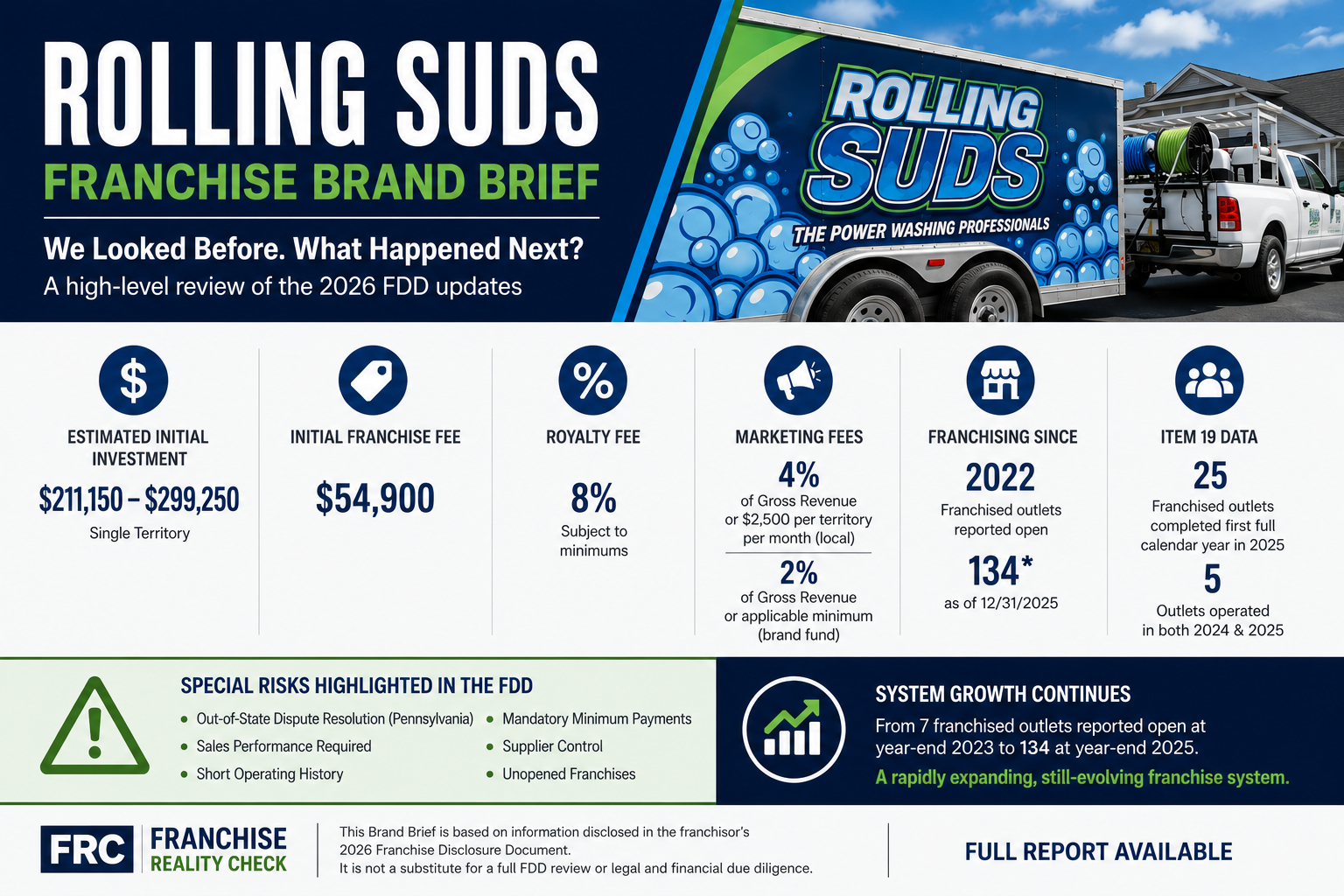
2026 Rolling Suds At-A-Glance
FDD Reviewed: 2026 Franchise Disclosure Document
Franchisor: Rolling Suds Franchising LLC
Franchising Since: 2022
Business Model: Residential and commercial exterior power washing and soft washing
Estimated Initial Investment: $211,150 to $299,250 for a single territory
Initial Franchise Fee: $54,900
This Franchise Brand Brief is for educational and informational purposes only. It is not legal, financial or investment advice. The risk signals, commentary and conclusions expressed herein represent the opinions of the author based on the information reviewed. Prospective franchisees should independently verify all information and consult qualified legal, financial and other professional advisors before investing.
Rolling Suds is a franchise I have examined before. My earlier reporting on the brand drew significant attention, particularly around the rapid pace of franchise sales and the way franchise outlets and territories were represented in the company's disclosures.
Now, with another year of franchise activity behind the brand and a new 2026 Franchise Disclosure Document, there is substantially more information available to evaluate.
The latest FDD shows a system that has continued to expand rapidly, but it also introduces significant changes at the corporate level and provides a larger pool of operating franchisees in its financial performance representation. At the same time, several of the issues I identified as worthy of closer examination in earlier FDDs remain relevant, including the number of franchise agreements sold compared with operating outlets, mandatory minimum fees, required purchases, and the economics of operating multiple territories.
Here is the high-level Rolling Suds Brand Brief.
The Investment
According to the 2026 FDD, the estimated initial investment to open a single Rolling Suds territory ranges from $211,150 to $299,250, compared with $186,150 to $251,850 disclosed in the 2025 FDD. The initial franchise fee remains $54,900.
Rolling Suds also offers multi-territory arrangements. The estimated investment for three territories is now $329,585 to $431,650, including $164,700 in initial franchise fees. That estimate is important to read carefully because the multi-territory total does not necessarily represent the full long-term capital required to fully develop every acquired territory. Franchisees operating multiple territories are subject to a vehicle development schedule requiring additional service vehicles as the business develops.
The increase in the disclosed investment range from 2025 to 2026 is notable, particularly at the upper end, where the single-territory estimate increased by more than $47,000.
The Ongoing Fee Structure
Rolling Suds franchisees pay an 8% royalty, subject to minimum royalty requirements that begin after the initial operating period.
Marketing obligations add another significant layer. Franchisees must generally spend the greater of 4% of gross revenue or $2,500 per territory per month on local advertising. They must also contribute the greater of 2% of gross revenue or an applicable minimum contribution to the brand fund.
Additional recurring charges include technology, website, SEO, telephone and bookkeeping-related fees.
The minimum-payment structure deserves particular attention. In fact, the 2026 FDD itself identifies "Mandatory Minimum Payments" as a special risk, warning prospective franchisees that minimum royalty or advertising fund payments may be required regardless of sales levels. It also identifies required sales performance, supplier control, the franchisor's short operating history and the number of unopened franchises as special risks.
Financial Performance: More Franchisee Data Is Now Available
One of the more meaningful developments in the 2026 FDD is the evolution of Rolling Suds' Item 19 Financial Performance Representation.
Earlier disclosures relied heavily on the performance of the long-established affiliate-owned Rolling Suds business. That operation dates back to 1990 and operates across a substantially larger service area than the territory typically granted to a franchisee.
The 2026 FDD still includes information about the affiliate-owned operation, but it now provides additional data from 25 reporting franchised outlets that operated for the full 2025 calendar year and completed their first full calendar year of operation. It also provides year-over-year information for five reporting franchise operations that operated throughout both 2024 and 2025. Where multiple territories were operated by the same franchisee as one business, those territories may be combined into a single franchisee observation.
This is an improvement in the amount of franchise-level operating data available to prospective buyers. However, understanding what the Item 19 numbers mean requires looking closely at which franchisees are included, how multiple territories are treated, how long the businesses have operated, and how the results compare with the economics presented by the affiliate-owned operation.
Rapid Growth, But the Outlet Numbers Require Context
Rolling Suds has grown quickly since it began franchising in 2022.
The 2024 FDD reported just seven franchised outlets at the end of 2023, while also reporting 84 signed franchise agreements for outlets that had not yet opened. At that time, the franchisor projected 36 new franchised outlets during the following fiscal year.
That gap between franchise agreements sold and operating businesses was one of the issues that made Rolling Suds worth watching.
The newer disclosures show substantial progress in converting sold territories into reported operating outlets. However, the way an "outlet" is defined is important when evaluating that growth. The 2025 FDD specifically stated that, for purposes of Item 20, an outlet represented an open territory for which the franchisee had acquired a corresponding service vehicle.
For a franchise system built around multi-territory sales, the number of reported outlets should therefore not automatically be interpreted as the number of independently owned franchise businesses. One franchisee may account for multiple territories or outlets.
This distinction matters when assessing system size, franchisee concentration and the actual number of independent operators who have successfully launched businesses.
Required Purchases and Supplier Control
Rolling Suds exercises substantial control over the products, equipment and services franchisees use.
The 2025 FDD estimated that required or approved purchases represented approximately 90% to 100% of the cost of establishing the franchise and approximately 35% to 45% of ongoing operating costs. It also disclosed that the franchisor and its affiliates could derive revenue from required franchisee purchases.
Rolling Suds Products, an affiliate owned by company principals, serves as a required equipment provider. The 2026 organizational structure also includes Rolling Suds Nationwide, an affiliate formed in 2025 to provide national-account sales services.
Supplier control is not unusual in franchising, but the financial relationship between the franchise system, its affiliates and franchisee purchasing deserves closer review when a significant portion of startup and operating expenditures flows through required or designated sources. The franchisor itself continues to identify supplier control as one of the special risks prospective franchisees should consider.
A Significant Corporate Change
The 2026 FDD introduces a notable change in Rolling Suds' ownership and leadership structure.
Rolling Suds Holdings is now disclosed as a subsidiary of Big Picture Brands, LLC, a company formed in April 2026. Big Picture Brands is described as the majority interest-holder of Rolling Suds and is owned by David Barr and Rolling Suds founder Aaron Harper.
David Barr became Chairman and interim CEO, while Harper moved into the role of founder and Chief Growth Officer.
For prospective franchisees, a change in majority ownership and executive leadership is material context. The long-term impact cannot be determined from the FDD alone, but buyers should understand who now controls the franchise system, what changed as part of the transaction, and whether the new ownership structure is likely to affect strategy, support, franchise development or system economics.
What Stands Out
The 2026 Rolling Suds FDD presents a more mature franchise system than the one I first examined. There are more operating franchisees, substantially more franchise-level performance data and continued expansion of the brand.
But rapid growth does not eliminate the questions raised by rapid franchise sales.
The system still carries a special-risk disclosure concerning a significant number of signed-but-unopened franchises. Franchisees face minimum royalty and marketing obligations, substantial required advertising expenditures and significant franchisor control over suppliers. The multi-territory structure also means that headline outlet counts require additional context when evaluating the actual size and health of the franchisee network.
The new majority ownership structure adds another factor prospective buyers should investigate.
None of these issues, standing alone, determines whether Rolling Suds is a good or bad franchise investment. They do, however, identify areas where a prospective franchisee should look beyond the franchise sales presentation and understand exactly how the system has evolved.
The Reality Check
Rolling Suds is no longer the very early-stage franchise system reflected in the FDD I originally reviewed. The 2026 disclosures provide more operating history and more franchisee performance information, which gives prospective buyers more data to work with than was previously available.
At the same time, this remains a relatively young franchise system that has expanded quickly. The relationship between territories sold, territories reported as open, individual franchise operators and businesses that have exited the system deserves careful examination. So do the economics created by minimum fees, required marketing expenditures, multi-territory development obligations and affiliate supplier relationships.
For someone considering Rolling Suds, the question is no longer simply whether the brand can sell franchises. It has clearly demonstrated that ability.
The more important question now is what the growing body of operating data tells us about the franchisees who bought them.
Want the Full Reality Check?
This Brand Brief is designed to give you a high-level look at some of the most important information contained in the franchise disclosure documents. The full Franchise Brand Report goes deeper; examining the FDD, financial performance representations, franchise system growth and turnover, litigation and bankruptcy disclosures, franchisor financial health, fees, supplier relationships, franchisee obligations, and other factors that may warrant closer attention before you invest in this or any other brand. Full brand reports include relevant FDD’s and are available through the Franchise Reality Check Shop.
This Franchise Brief is provided for informational and educational purposes only and is based primarily on the Franchise Disclosure Document(s) identified above. It is not legal, financial, tax, or investment advice, nor is it a recommendation to purchase or avoid any franchise. Information may change, and prospective franchisees should review the franchisor's current FDD, conduct independent due diligence, speak with current and former franchisees, and consult qualified professional advisors before investing. Any ratings, observations, or conclusions reflect Franchise Reality Check's independent analysis and do not guarantee future performance or investment outcomes.
