
Scenthound Franchise Brand Brief: Strong Growth, but How Long Until the Economics Catch Up?
High-level review of the 2024, 2025 and 2026 Franchise Disclosure Documents
Scenthound At a Glance
Brand: Scenthound
Industry: Dog wellness, grooming and routine care services
Franchisor: Scenthound Franchising LLC
Franchising Since: 2019
FDDs Reviewed: 2024, 2025 and 2026
Relevant FDD Topics: Items 3, 5, 6, 7, 8, 12, 13, 17, 19, 20 and 21
Estimated Initial Investment: $322,999 to $553,269
Initial Franchise Fee: $49,900
Overall Risk Signal: 🟡 Yellow
Primary Concern: Mature locations report encouraging economics, but newer locations show a much thinner margin while the franchisor moves substantial cash to its parent and begins paying an affiliate a new fee equal to 2% of store sales.
This Franchise Brand Brief is for educational and informational purposes only. It is not legal, financial or investment advice. The risk signals, commentary and conclusions expressed herein represent the opinions of the author based on the information reviewed. Prospective franchisees should independently verify all information and consult qualified legal, financial and other professional advisors before investing.
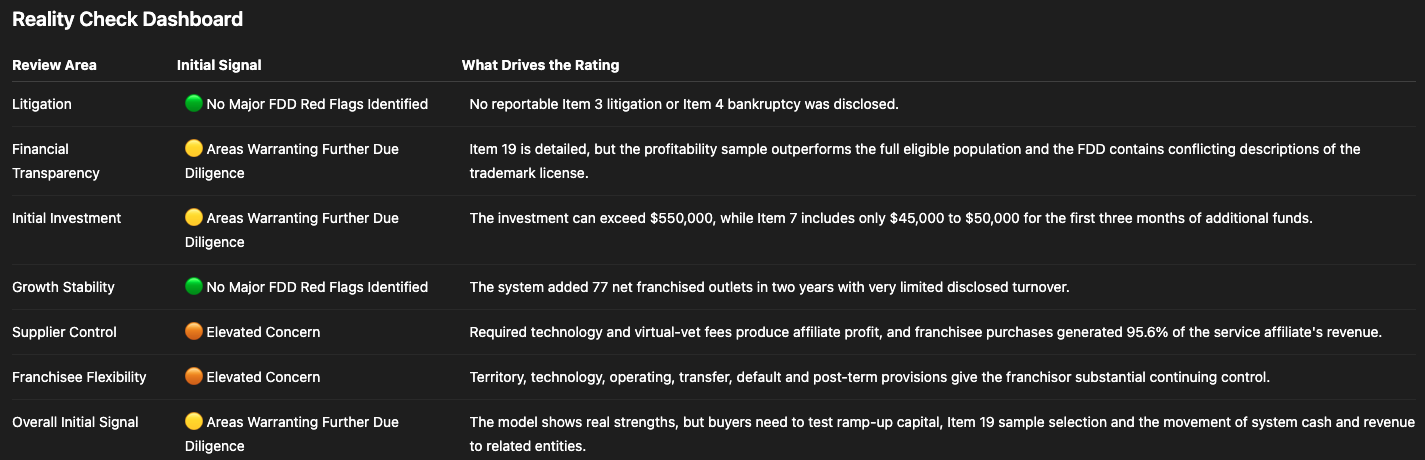
These signals describe issues identified in the documents reviewed. They are not predictions of whether a particular franchise investment will succeed or fail.
Why This Report Matters
Scenthound has many of the characteristics that make a franchise attractive to buyers and franchise advisors. It operates in the large and growing pet-services category, uses a recurring membership model, occupies a relatively small retail footprint and has expanded without the level of disclosed closures seen in many rapidly growing systems.
The 2026 FDD also provides something buyers should value: a detailed Item 19 that reports both revenue and store-level operating income, including separate results based on the year locations opened. Those disclosures provide legitimate support for the positive reputation Scenthound has developed in the franchise marketplace.
But the same Item 19 also reveals the central issue for a new buyer.
A mature Scenthound and a newly opened Scenthound are not yet the same investment.
The older locations report meaningful operating income. The newest reporting cohort had average operating income of only $12,584, while its median location was slightly negative during 2025. That does not mean the model is failing. It suggests that the path to mature-unit economics may take longer and require more capital than a buyer could assume from the overall averages or the three-month working-capital allowance in Item 7.
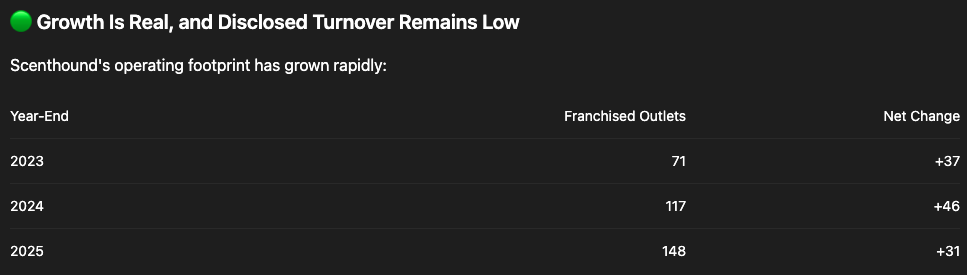
Scenthound growth by reported numbers.
During 2025, Scenthound reported 33 new franchised openings, one termination, one outlet reacquired by the franchisor and no non-renewals or outlets ceasing operations for other reasons. Only three transfers were reported during the year.
That is a favorable history for a system growing at this pace. The 2026 FDD also listed 49 signed franchise agreements for outlets that had not yet opened and projected 56 new franchised outlets during the following fiscal year.
Prospective buyers should still determine how many of the 49 unopened commitments are progressing on schedule and how multi-unit development obligations affect the reported pipeline. But based on the three FDDs reviewed, Scenthound's expansion has translated into a substantial number of operating locations rather than remaining primarily a franchise-sales story.
Signal: 🟢 Green
🟢 The Mature-Unit Economics Are Encouraging
The 2026 Item 19 reports revenue for all 114 franchised locations that operated continuously throughout 2025 and had been open for at least 12 months by year-end.
Across those 114 locations:
Average gross revenue was $461,041.
Median gross revenue was $427,445.
Average membership count was 483.
Approximately 84% of average revenue came from members.
The recurring membership component is a meaningful strength. It may give an established location a more predictable revenue base than a grooming business that must generate each visit as a separate transaction.
Scenthound also reports operating income for 82 qualifying locations that supplied complete financial information. For that group, average net operating income was $58,264, or 11.5% of revenue. Median net operating income was $44,105, or 9%.
The strongest evidence for the model appears among the 27 reporting locations opened in 2022 or earlier. Those locations averaged $606,138 in gross revenue and $108,298 in net operating income, a 17.8% average margin. Median operating income was $90,148, or 14.8%.
Those are not merely top-quartile results. They support the conclusion that a mature Scenthound can become a productive operating business.
Signal: 🟢 Green
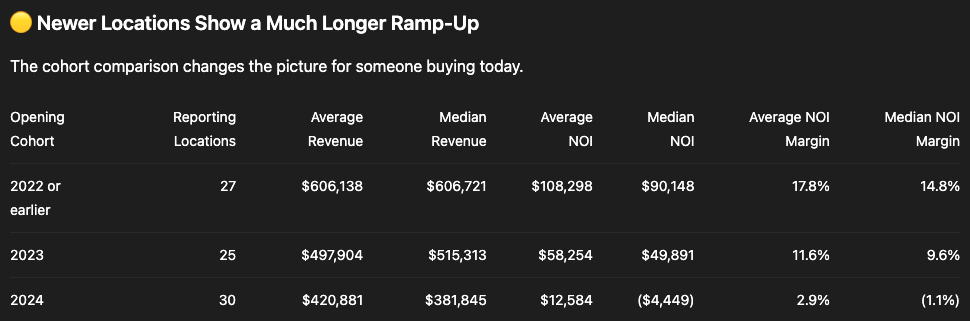
Net Operating Income by age of location; newer locations are taking a longer time to reach the same revenue level as older locations.
The progression is difficult to ignore. Locations opened in 2024 had a positive average operating result for 2025, but the median reporting location remained slightly negative. Even within that cohort, the bottom two quartiles reported negative average operating income.
This could reflect a normal maturation curve. It may take time to build memberships, improve labor efficiency and spread fixed occupancy and technology costs across a larger revenue base. If so, Scenthound's older cohorts show what locations may become after that ramp-up.
The buyer's risk is the time and capital required to get there.
Item 19 net operating income is also not the same as cash available to the owner. The calculation excludes depreciation and amortization, interest expense, expenses related to more than one location owned by the same franchisee, automobile expenses and certain other costs. Scenthound does adjust payroll to include a market-rate manager when an owner performs significant work without recording corresponding payroll, which makes the disclosure more useful. Debt service and several real cash demands, however, remain outside the calculation.
Signal: 🟡 Yellow
🟡 The Item 19 Profitability Sample Performs Better Than the Full Population
Scenthound deserves credit for reporting gross revenue for every qualifying location and for expanding the detail in its 2026 Item 19. The profitability tables, however, do not include the entire eligible population.
Of 114 qualifying locations, 82 supplied the complete, reliable and consistent financial information required for the operating-income tables. The 82-location profitability group averaged $505,363 in gross revenue. All 114 qualifying locations averaged $461,041.
The group used to report profitability therefore generated approximately 9.6% more revenue than the full eligible population.
The selection gap is particularly relevant in the newest cohort. Only 30 of the 45 qualifying locations opened during 2024 supplied the information used in the cohort profitability tables.
This does not invalidate the operating-income disclosure. It means buyers should not apply the reported margins to the entire system without additional verification. Prospective franchisees should ask how the 32 omitted locations performed, why their financial information was unavailable or considered incomplete, and whether lower-revenue locations were less likely to be included.
Signal: 🟡 Yellow
🟡 Item 7 May Understate the Capital Needed for the Ramp-Up
The estimated initial investment for one Scenthound ranges from $322,999 to $553,269, including a $49,900 initial franchise fee.
The 2026 FDD also increased required grand-opening marketing to $20,000 to $35,000, compared with $12,000 to $17,000 in the prior disclosure. The franchisor determines the applicable amount based on the market.
Item 7 includes only $45,000 to $50,000 in additional funds for the first three months. The FDD properly states that this is an estimate and that actual needs vary. Nevertheless, a three-month allowance deserves close scrutiny when the median location in the newest reporting cohort remained slightly unprofitable over its first full calendar year.
The ongoing fee structure adds to the early operating burden. Franchisees currently pay a 6% royalty, a brand-fund contribution of up to 1.5% and local advertising equal to 5.5% of gross revenue, subject to a $25,000 annual minimum. The royalty can increase by one percentage point per year, up to 9%, and the brand-fund contribution may rise to 3% under the limits described in the FDD.
The monthly technology fee is currently $675 after point-of-sale activation. It is subject to a 10% annual increase, compounded, and the agreement permits larger catch-up adjustments for prior years in which no increase was implemented.
Buyers should prepare a capitalization plan that covers the period required to reach mature membership and revenue levels, not simply the three months shown in Item 7.
Signal: 🟡 Yellow
🟠 The Franchisor Is Profitable, but Cash Is Moving to the Parent
Scenthound Franchising is not reporting the financial profile of a distressed early-stage franchisor.
In 2025, it reported:
$6.11 million in total revenue
$1.85 million in net income
$1.88 million in operating cash flow
$1.65 million in ending member's equity
Royalty revenue increased from approximately $2.42 million in 2024 to $3.50 million in 2025, a 44.9% increase. That is consistent with a growing base of operating locations producing recurring franchisor revenue.
But the cash-flow statement shows that the franchisor advanced $2.11 million to its parent during 2025, more than the cash generated from operations. Cash ended the year at only $158,601.
At December 31, 2025, the parent owed Scenthound Franchising $5.95 million. The advances were unsecured, did not bear interest, had no specific repayment terms and were not expected by management to be settled within the following year. By June 30, 2026, the amount due from the parent had increased to approximately $6.77 million.
This does not establish that the franchisor is insolvent or unable to support franchisees. The company is profitable and reported positive equity. It does show that a substantial share of the cash generated by the franchising entity has been moved to its parent instead of remaining available inside the entity contractually responsible for franchise support.
Prospective buyers should ask what expenses and investments are paid at the parent level, what resources remain available to support continued system growth, and whether the parent balance is expected to be repaid.
Signal: 🟠 Orange
🟠 A New 2% Intellectual Property Fee Changes the Franchisor Economics
The 2026 audited financial statements disclose a new related-party license agreement effective January 1, 2026. Under that agreement, Scenthound Franchising must pay Scenthound IP an annual fee equal to 2% of store sales from franchised and company-owned outlets, as defined in the agreement.
Because franchisees currently pay a 6% royalty, a 2% charge based on franchised store sales could be economically equivalent to roughly one-third of the franchisor's gross royalty rate, depending on how store sales are defined and calculated. The fee also applies to company-owned store sales.
The arrangement matters because it redirects revenue from the franchising entity to a related intellectual-property owner while the franchising entity remains responsible for supporting the network.
There is also a direct inconsistency inside the 2026 FDD:
Item 13 describes the trademark license as exclusive and perpetual, terminable only if the franchisor misuses the marks or willfully allows franchisees to misuse them.
The audited financial statements describe a 99-year, non-exclusive license that either party may terminate on 30 days' written notice.
Those descriptions cannot easily be reconciled. A prospective buyer should request a copy of License Agreement II and a written explanation of the termination rights, the meaning of store sales, the expected annual cost of the 2% fee and the effect on resources available for franchise support.
Scenthound publicly announced an investment partnership with VMG Partners in October 2025. The new license agreement became effective January 1, 2026, and the company subsequently announced a new board and expanded executive team. That sequence provides relevant context, but the available documents do not establish that VMG required the license arrangement or directly benefits from it. The timing should be investigated without presenting correlation as causation.
Signal: 🟠 Orange
🟠 Affiliate Revenue and Supplier Control Deserve Attention
Scenthound requires franchisees to use designated technology and virtual-veterinary services supplied through its affiliate, Scenthound Services. The FDD now expressly states that those fees include markups that exceed the affiliate's direct costs and may generate a profit.
During 2025, Scenthound Services received approximately $4.40 million in revenue from franchisee purchases. That represented 95.6% of the affiliate's total revenue.
The FDD estimates that purchases from the franchisor, affiliates or designated and approved vendors will represent approximately 50% to 75% of a franchisee's initial purchases and 15% to 30% of monthly operating purchases, excluding rent, royalties and labor.
Supplier control is common in franchising and can create consistency and purchasing efficiencies. It also creates a financial relationship in which franchisees are a primary revenue source for an affiliate and have limited ability to seek lower-cost alternatives.
Prospective buyers should verify the full cost of required technology and services, how those costs have changed, whether comparable alternatives exist and how the 10% compounded technology-fee increase could affect store-level margins over the life of the agreement.
Signal: 🟠 Orange
🟠 The Agreement Provides Limited Franchisee Flexibility
Scenthound grants a Designated Territory and generally agrees not to operate or license another permanent Scenthound outlet inside it, subject to the reservations stated in the agreement. The FDD nevertheless says the franchisee does not receive an exclusive territory. The franchisor and its affiliates retain rights involving other brands, alternative distribution channels and certain nontraditional locations, while the franchisee is restricted from marketing or selling outside the Designated Territory without approval.
The franchisor may also modify or eliminate territorial rights after a franchise default as an alternative to termination. Multi-unit developers must meet their development schedules to preserve their rights, and each future unit is opened under the franchisor's then-current form of franchise agreement.
The broader agreement remains heavily franchisor-favorable regarding operating standards, technology, transfers, defaults, termination and post-term restrictions. These provisions are not unique to Scenthound, but they matter in a business requiring a substantial upfront investment and a potentially long ramp-up. Buyers should have the franchise agreement reviewed by experienced franchise counsel and model the cost of an early exit before signing.
Signal: 🟠 Orange
The Reality Check
Scenthound appears to be one of the stronger emerging franchise concepts I have reviewed. It has real unit growth, very limited disclosed turnover, a recurring membership model, improving economics as locations mature and a franchisor that is generating profit and operating cash.
Those strengths should not be minimized.
The 2026 FDD also shows why a strong concept can still require serious due diligence. The newest reporting cohort produced only a 2.9% average operating margin, and its median location was slightly negative. The operating-income sample performs better on revenue than the full eligible population. Item 7 provides only three months of additional funds. More than $6.7 million was due from the parent by mid-2026, and a new affiliate license fee now claims 2% of system store sales under a license described differently in Item 13 and the financial statements.
The central question is not whether Scenthound has a viable mature-unit model. Its FDD provides evidence that it does.
The question is whether a new buyer has enough capital, time and local demand to survive the ramp-up and reach it, while the franchisor continues scaling and moving part of the system's economics to related entities.
Overall Risk Signal: 🟡 Yellow
The yellow rating does not mean Scenthound should be avoided. It means the brand combines meaningful strengths with specific issues that cannot be resolved from the headline Item 19 averages alone.
This is a promising model with serious due-diligence questions.
Questions Prospective Scenthound Buyers Should Ask
Before investing, buyers should seek clear answers to the following:
How many months did current franchisees take to reach store-level break-even and positive cash flow?
How much additional working capital did owners actually require beyond the amount shown in Item 7?
How did the 32 qualifying locations omitted from the operating-income tables perform on revenue and profitability?
Why did only 30 of the 45 qualifying locations opened in 2024 provide complete financial information?
How many locations generated enough cash to cover buildout or acquisition debt after all excluded expenses?
What explains the performance gap between the 2024 cohort and locations opened in 2022 or earlier?
What expenses or support functions are funded at the parent level with the cash advanced by Scenthound Franchising?
When, if ever, is the $6.77 million due from the parent expected to be repaid?
How is store sales defined under License Agreement II, and how much is the new 2% fee expected to cost annually?
Why does Item 13 describe the trademark license differently from the audited financial statements?
How will technology, virtual-vet and other affiliate fees affect franchisee margins as the fees increase?
How many multi-unit developers are on schedule, and how many have delayed or reduced their development commitments?
Want the Full Reality Check?
This Brand Brief is designed to give you a high-level look at some of the most important information contained in the franchise disclosure documents.
The full Franchise Brand Report goes deeper, examining the FDD, financial performance representations, franchise system growth and turnover, litigation and bankruptcy disclosures, franchisor financial health, fees, supplier relationships, franchisee obligations and other factors that may warrant closer attention before you invest in this or any other brand. Full brand reports include the relevant FDDs and are available through the Franchise Reality Check™ Shop.
This Franchise Brief is provided for informational and educational purposes only and is based primarily on the Franchise Disclosure Documents identified above. It is not legal, financial, tax or investment advice, nor is it a recommendation to purchase or avoid any franchise.
Information may change, and prospective franchisees should review the franchisor's current FDD, conduct independent due diligence, speak with current and former franchisees, and consult qualified professional advisors before investing. Any ratings, observations or conclusions reflect Franchise Reality Check™'s independent analysis and do not guarantee future performance or investment outcomes.
