
McDonald’s plans a major restaurant modernization program, with projected efficiency gains and financial support for franchisees. Its announcement raises a broader ownership question: whether the next required investment fits the cash flow, financing and remaining timeline of the business an owner already operates.
Relevant FDD Topics: Item 6: Other Fees; Item 7: Estimated Initial Investment; Item 8: Restrictions on Sources of Products and Services; Item 11: Franchisor’s Assistance, Advertising, Computer Systems, and Training; Item 17: Renewal, Termination, Transfer, and Dispute Resolution; Item 19: Financial Performance Representations.
This report provides educational commentary based on McDonald’s public company announcements available as of October 28, 2026. Company estimates describe expected outcomes, not verified results for an individual restaurant. Interpretations and conclusions are the opinions of Franchise Reality Check™. Hypothetical calculations are labeled separately. The FDD topics identify areas for further review; this report does not analyze a current McDonald’s FDD or establish any individual franchisee’s contractual obligations. This is not legal, financial, or investment advice. Franchise Reality Check™ is not affiliated with McDonald’s or its affiliates.
Buying a franchise gets you into the business. Staying in that business may require another substantial investment, followed by another. The equipment ages. The building needs work. The brand changes its design. A new technology platform arrives with a new set of expectations. Meanwhile, the loan you took out for the last round of improvements may still be very much alive.
McDonald’s latest strategy puts that reality into focus. Its Restaurant > NEXT program anticipates approximately $800,000 in incremental investment for a traditional U.S. drive-thru restaurant. That is a company estimate for a particular restaurant format, not a universal invoice or the final amount every franchisee will personally fund. But it is enough to move a question often left in the background to the center of the ownership discussion: Can you afford the business you are buying over the years you intend to own it? [1]
What McDonald’s has announced
McDonald’s describes NEXT as a strategy to improve demand, restaurant productivity and the customer experience. Restaurant modernization and technology form part of that plan. The company’s FAQ estimates roughly $100,000 in gross annual cash-flow benefits for an average U.S. restaurant after full deployment, with most expected to reach the restaurant’s bottom line over time. [1]
Its September 23 announcement also projects approximately four-year franchisee payback after partnering support. McDonald’s plans about $8.5 billion in support through 2036, including about $5 billion through 2030, using both rent relief and capital. These are forward-looking company expectations. They are not a guarantee of any particular operator’s investment, savings or return. [2]
That support belongs in the discussion. So does the company’s stated intention to phase implementation and incorporate investments into remodel cycles where possible. [1] Evaluating this proposal fairly requires looking at both the investment and the assistance, then determining what each means for an individual restaurant.
The opening budget does not establish the cost of long-term ownership
Prospective franchisees often organize their analysis around getting open. They examine the franchise fee, construction, equipment, deposits and working capital. Those numbers feel concrete because someone needs to write checks for them before the first customer arrives.
Future reinvestment is easier to underestimate. It may be years away, its exact cost may be unknown, and the current owner may describe the building as recently remodeled. None of that answers what the next owner will need to spend during their own ownership period.
For someone buying an existing franchise, this is particularly important. A purchase price supported by historical earnings can look reasonable until near-term capital needs enter the calculation. A restaurant generating cash today may also be approaching an expensive equipment replacement or modernization cycle.
The cost of acquiring a business and the cost of keeping that business competitive belong in the same investment analysis. A buyer needs a dated capital plan, not simply reassurance that the location is in good shape.
The projected payback needs a restaurant-level explanation
An approximately four-year payback estimate is useful information. It should prompt a franchisee to ask how the estimate was built and how closely its assumptions resemble their restaurant. [2]
What investment is included? Which expenses are excluded? How much support is assumed? When do the benefits begin? Are the projected improvements based on a mature rollout or an early implementation period? What happens if construction costs more than expected or the benefits arrive later?
A separate hypothetical example shows how sensitive that calculation can be. In each scenario below, annual improvement means additional operating cash after ongoing project costs, but before financing and taxes.
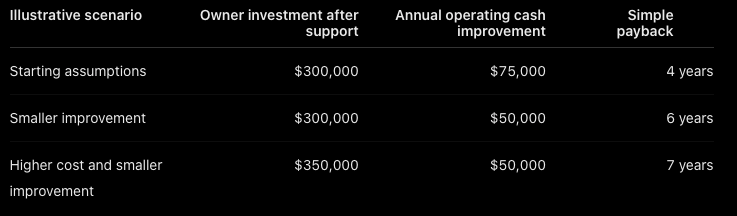
Source: hypothetical examples calculated for this report. Simple payback equals owner investment divided by annual operating cash improvement.
These are illustrative calculations, not estimates of McDonald’s results. They exclude financing, taxes, the time value of money and any resale benefit. Their purpose is to show how quickly a familiar payback headline changes when two assumptions move.
A systemwide projection is the starting point for a restaurant-level model. An owner should be able to see the assumptions, change them and understand the consequences.
The timing of support changes the funding requirement
McDonald’s proposed combination of rent relief and capital support illustrates another important distinction: the amount of assistance and its timing are separate questions. [2]
An upfront contribution can reduce the money an owner needs to raise before work begins. Rent relief can improve cash flow over time. Both can have substantial value, but future savings do not necessarily pay a contractor’s deposit today.
Imagine a hypothetical project with $100,000 of support. Receiving that amount during construction creates a different funding need from receiving $20,000 annually over five years. Even before considering the time value of money, the owner may need to borrow more under the second arrangement. Eligibility conditions, payment dates and any repayment provisions also deserve attention.
The practical question is straightforward: How much cash must leave the owner’s account, on which dates, before the benefits and assistance arrive?
Operational improvements must translate into measurable benefits
Technology can improve accuracy, reduce repetitive work and help employees serve customers. Those improvements can be valuable. But a productivity improvement and a reduction in payroll expense are not automatically the same thing.
If software saves several employee hours across a week, the restaurant may still require the same minimum staffing during each shift. The benefit could appear as faster service, fewer mistakes or additional capacity rather than fewer paid hours. An owner needs to identify which outcome the forecast assumes and how that outcome will be measured.
The same scrutiny should apply to ongoing costs. Implementation, training, maintenance and subscriptions can affect the result. A realistic model includes the full operating change, including the costs of making the new system work.
This is not an argument against modernization. It is a standard for evaluating it. A useful investment case connects the proposed improvement to a measurable financial or operational result.
The recovery period must fit the ownership timeline
An owner expecting to operate for another fifteen years can assess a major project differently from someone planning to sell in three. The second owner needs to understand whether a buyer is likely to pay for the improvement and what evidence supports that expectation.
A franchisee should also compare the expected recovery period with the remaining franchise and lease terms. Those dates determine the period over which the owner expects to operate, while the documents determine what happens at renewal or transfer. Specific obligations require review of the actual agreements and applicable program terms.
This report does not establish that every McDonald’s franchisee must undertake the same project, on the same schedule, at the same price. The public announcements do not resolve those individual questions. They demonstrate why buyers and existing owners need to ask them.
What a prospective buyer or current owner should do with this information
What is my complete project cost? Include construction, equipment, implementation, downtime, financing and a contingency allowance.
What support applies to my location? Obtain the amounts, eligibility rules, payment dates and conditions in writing.
What supports the projected return? Ask for comparable restaurant results, the range of outcomes and the assumptions behind the estimate.
What happens in a weaker scenario? Model delays, overruns, smaller savings and slower sales improvement.
How does this fit my timeline? Compare the recovery period with franchise and lease terms, other upcoming capital needs and the intended exit date.
A franchise system needs to evolve. Customers change, equipment wears out and competitors improve. Responsible reinvestment can protect a business and strengthen its future. Franchisees also need a clear explanation of the capital required and a credible path to recovering it.
McDonald’s has put projected costs, support and benefits into the public discussion. The next question for an individual owner is how those projections translate into their own obligations and cash flow.
For anyone considering a franchise, the lesson begins before signing: Do not stop at whether you can afford to buy it. Determine what staying in the business could require, and whether your financial plan can support it. The opening budget gets the doors unlocked. It does not tell you everything ownership will cost.
Explore the franchise relationship before committing capital: View our independent franchise brand reports.
Sources
McDonald’s: FAQ, McDonald’s > NEXT, September 23, 2026. Investment estimates, gross benefit projections, implementation and franchisee collaboration.
McDonald’s Advances NEXT Strategy to Become First Choice for More Customers, More Often, September 23, 2026. Company announcement of projected franchisee payback and partnering support.
