
The Picklr Problem Deepens: A Disputed Buyback, Franchisee Bankruptcies, and Corporate Chapter 11
A reported July settlement preceded five franchise operating companies’ September bankruptcies. The intended corporate buyer then filed its own case. Court filings and the 2026 FDD reveal the financial pressure behind the growth story.
Relevant FDD Topics: Item 3: Litigation; Item 4: Bankruptcy; Item 7: Estimated Initial Investment; Item 17: Renewal, Termination, Transfer, and Dispute Resolution; Item 19: Financial Performance Representations; Item 20: Outlets and Franchisee Information; Item 21: Financial Statements; Special Risk Disclosures.
Read the original report: The Picklr Problem: Unlawful Earnings Claims, Franchisee Struggles, and a Franchise Fantasy
Watch our podcast discussion: The Picklr discussion with Genevieve McDaniel and Dan Collins on YouTube
This report provides educational commentary based on franchise disclosures, publicly accessible docket information, company statements reported by identified publications, and other cited reporting available as of the research cutoff. Allegations and disputed requests are not court findings. Interpretations and conclusions are the opinions of Franchise Reality Check™. This is not legal, financial, or investment advice. Franchise Reality Check™ is not affiliated with The Picklr or its affiliates.
The questions raised in My earlier report now have financial consequences
In my earlier Reality Report, The Picklr Problem, Franchise Reality Check™ examined the distance between The Picklr’s public earnings and expansion claims and the evidence available in its franchise disclosures. We questioned the use of selected performance figures, what the advertised growth counts actually measured, and what buyers could reasonably conclude about the business they were being asked to fund.
The new developments bring those concerns into a much more concrete setting: bankruptcy petitions, operating statements, and a disputed agreement to take over five franchisee-operated clubs.
On September 24, 2026, five affiliated companies operating Picklr clubs filed Chapter 11 cases in Florida. On October 9, Picklr, Inc. filed its own Chapter 11 case in Texas. Picklr Clubs, Inc. followed on October 10. These are separate cases involving different entities, and their distinction matters. [1–4]
The story now involves financial distress at both a franchise ownership group and the corporate organization. It also involves an important sequence: the franchise owners reportedly negotiated a settlement and proposed exit before filing bankruptcy, then sought to enforce the transaction against a corporate buyer that subsequently filed its own bankruptcy case.
That sequence deserves scrutiny. A negotiated exit can look like a solution on paper while leaving the owner exposed if the transaction does not close.
We also discuss The Picklr in our podcast conversation on YouTube. This written update examines the additional detail available in the corporate petitions and the 2026 FDD. The figures below retain their entity names and reporting dates because combining different companies, periods, and disputed claims would obscure what actually happened.
The chronology matters.
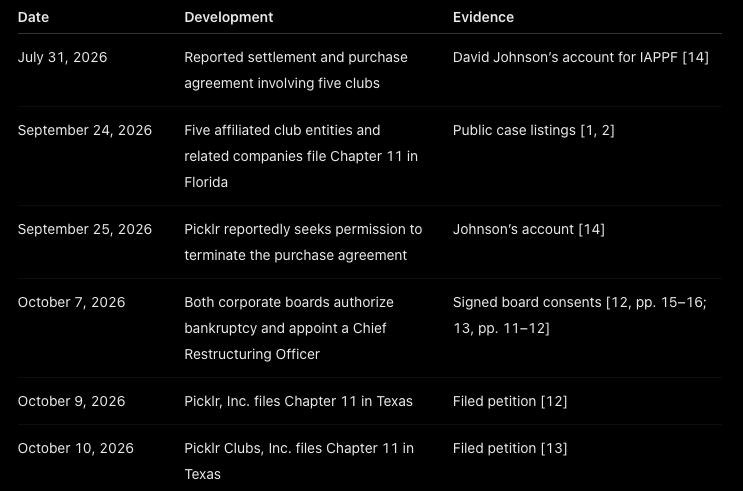
The settlement date comes from attributed reporting. The corporate filing dates and board actions are independently documented in the petitions reviewed for this report.
Five club companies, one affiliated ownership group
The September 24 filings include these five operating companies:
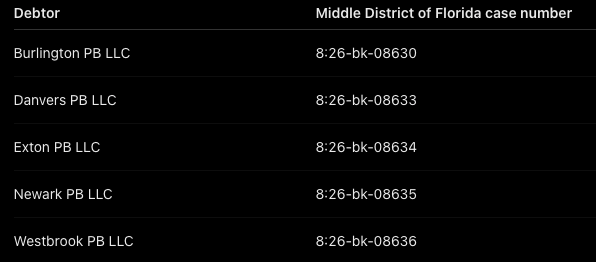
The cases sit within the larger affiliated group led by 3 Strand Holdings LLC, case 8:26-bk-08621-RCT. The lead docket identifies joint administration with 12 related cases. IAPPF’s October 3 reporting connects the clubs to the Maguire family’s Northeast franchise operation. [1, 2, 5]
Five separate club entities seeking protection is significant. However, it should not be represented as five unrelated franchise owners independently reaching the same outcome. Common ownership can bring shared financing, development commitments, management decisions, and exposure across locations.
The filings establish a serious problem within this operator group. Determining how much resulted from its own decisions, the franchise relationship, or the underlying facility economics requires more than counting petitions.
A proposed exit was already in place before the franchisee bankruptcies
David Johnson of IAPPF reports that a July 31, 2026 agreement would settle a franchise dispute through the acquisition of the five clubs, their leases and equipment, for $160,000 plus a reconciliation of revenues and expenses, with the franchise agreements ending. He reports that Picklr later paused the transaction. [14]
According to IAPPF’s review of the Florida proceedings, the franchisee group sought approval to sell assets, assume an asset purchase agreement with Picklr Clubs Inc., assign leases and contracts, and compel compliance. Picklr Clubs Inc. and Picklr Franchise Inc. opposed that relief and sought permission to terminate the agreement. [5]
The publicly available lead docket lists an October 20 trial concerning the sale and related relief. The effect of the subsequent corporate filings on the dispute and schedule remains to be established. [1]
For franchise buyers, the practical issue is the reliability of an exit or rescue arrangement. An agreement involving a troubled operator and a corporate buyer can become a contested obligation when both sides face financial pressure. Until the transaction closes and the relevant obligations are resolved, the owner’s exposure may remain substantial.
The available record does not establish that either side has prevailed on the merits.
The business significance extends beyond the legal contest. On this reported chronology, the owners were already trying to resolve the franchise relationship almost eight weeks before their petitions. Their later filings therefore cannot be understood solely as a sudden September operating setback. There was an earlier dispute and an agreed transaction whose completion became contested.
The $160,000 reported consideration is also not a valuation of the owners’ total investment or the entire economic cost of the transaction. Assumed leases, equipment obligations, adjustments, and releases can materially change what a buyer takes on and what a seller gives up. The underlying agreement is needed before assigning a total economic value to the deal.
For this report, the unresolved questions are specific: What dispute was being settled? What conditions had to be satisfied? When were leases, expenses, and operational responsibility supposed to transfer? What reason did Picklr give for pausing or ending the transaction? Did the operators incur additional losses while awaiting completion?
The petition’s creditor labels do not answer those questions, and a settlement is not an admission of wrongdoing. They do establish why the agreement and the competing motions belong at the center of the next stage of reporting.
Corporate bankruptcy is now a documented development
The filings followed corporate staff reductions. Athletech News reported on September 25 that The Picklr had cut staff and was evaluating options. The accessible reporting does not establish a verified headcount for those reductions. [11]
Public docket listings identify:

The filed petitions supplied for this report independently confirm both voluntary Chapter 11 filings. Picklr Clubs identifies Picklr, Inc. as its parent. Both companies' board consents, dated October 7, appoint Rick Rosenbloom as Chief Restructuring Officer and authorize the bankruptcy filings. [12, pp. 1, 15–16; 13, pp. 1, 3, 11–12]
Entity names are essential here. The May 2026 FDD names Picklr Franchise Inc. as the franchisor. It identifies Picklr Clubs, Inc. as the affiliate operating company-owned outlets. A petition under one name should not be attributed to another entity merely because both use The Picklr brand. The two corporate filings above are the ones verified for this report; they do not establish a separate petition by Picklr Franchise Inc. [6]
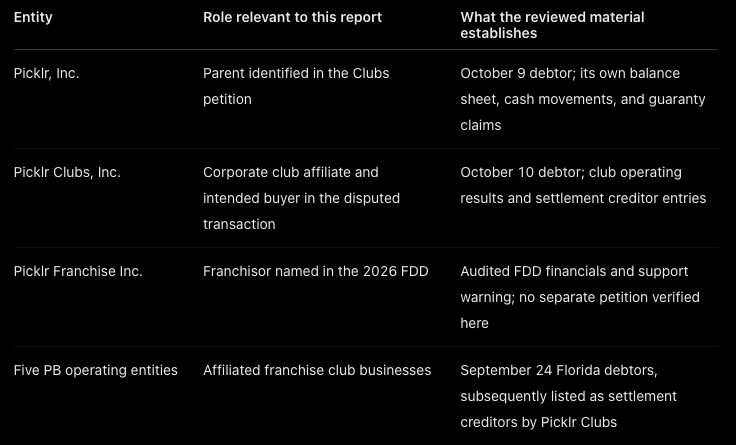
The brand name connects these businesses commercially. It does not make their assets, obligations, or cash interchangeable.
IAPPF reported on October 10 that the company announced a $4.5 million financing commitment, led by an investor group including a franchisee and subject to court approval. The company also said clubs and independently owned franchise locations continued operating. That describes the company’s announcement at that time, rather than confirmation that financing has since been approved or funded. [7]
Continued operation matters to members and franchisees. Successful restructuring will also require sufficient resources and an operating model capable of supporting the obligations that remain.
The financing announcement should be evaluated against what the money is intended to accomplish. How much would fund operations and support? How much would pay restructuring expenses? What conditions attach to the commitment? What obligations would survive the process? An announced commitment can be consequential without establishing that an individual club’s rent, debt, or operating losses have been resolved.
What the bankruptcy petitions reveal about the business
The petitions add direct evidence of financial pressure at the parent and corporate club operator. The attached financial reports are entity-specific accounting reports dated August 2026, not audited results for the entire franchise network or balances on the October filing dates.
Corporate club revenue did not cover rent and payroll
Picklr Clubs, Inc.'s August profit-and-loss statement reports the following: [13, pp. 14–16]
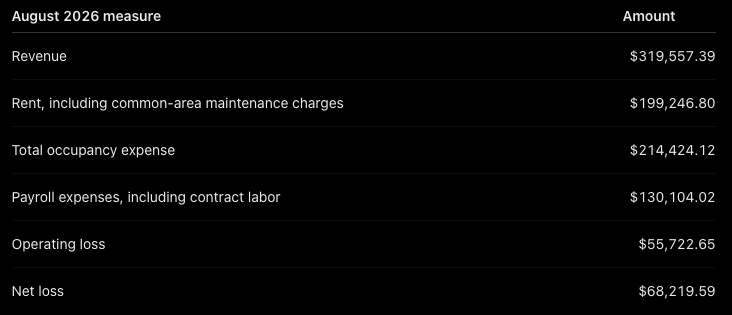
Rent and common-area charges alone consumed approximately 62.4% of revenue. Rent and payroll together totaled $329,350.82, exceeding revenue before merchandise costs, utilities, marketing, and other expenses. These percentages are calculated from the filed statement.
That is concrete evidence of an operating-cost problem at the corporate club entity during the reported month. The operating loss arose before the separately listed depreciation and interest expenses. It cannot be explained solely by those below-operating-line costs.
The report combines activity within Picklr Clubs; it does not provide a reliable club-by-club allocation or establish how many facilities generated the August revenue. It should not be presented as the performance of every Picklr franchise or as directly comparable to the FDD's full-year franchisee sample.
For the broader analysis, the distinction between an operating loss and a financing problem matters. Additional capital can cover a shortfall for a period. Sustainable operations require revenue sufficient to meet the continuing cost structure. The August statement gives readers an actual example of those costs exceeding the revenue available to carry them.
The parent's cash fell sharply while funding affiliated companies
Picklr, Inc.'s August 31 balance sheet reports $70,239.78 in bank accounts, $915,432.22 in total assets, and $2,385,767.62 in liabilities. The liabilities include an $844,591.45 Backd Loan and a $1.5 million line of credit. A recorded $735,001.26 investment representing 10% ownership of Black Bear Pickleball LLC accounts for approximately 80% of the asset total; that carrying value is not available cash or a verified sale value. [12, pp. 17–19]
The parent's August cash-flow statement shows cash declining from $653,123.91 to $70,239.78, a decrease of $582,884.13. It separately reports $400,000 transferred to Picklr Franchise and $80,000 to Picklr Clubs within financing activities. The Clubs statement records an $80,000 paid-in-capital inflow during the same month. [12, p. 22; 13, p. 13]
These disclosures show financial links among the entities and a sharp reduction in the parent's cash. They do not establish that the full cash decline was an operating loss or that these were the only funds available elsewhere in the organization. Transfers within a corporate group must not be counted twice as consolidated cash consumption.
The creditor lists connect the corporate cases to franchise disputes
Picklr Clubs lists Burlington PB, Danvers PB, Exton PB, Newark PB, and Westbrook PB as creditors under settlement-agreement entries, each showing $160,000. All five entries are designated contingent, unliquidated, and disputed. This is direct documentation in the corporate petition connecting it to the five September club debtors. The repeated figure does not establish five separate payments totaling $800,000; the underlying settlement must be reviewed to determine overlap. [13, pp. 6–8]
The same list contains two $9.66 million franchise-agreement entries, one for David A. Norton and one for Picklr DSN, LLC. Both carry the same three qualifications. It also lists matching $392,820 asset-purchase-agreement entries for Bella Vista Group, LLC and Michael and Rachel Boswick. The petition alone does not establish whether these paired entries represent distinct recoveries, overlapping claims, or alternative claimants. They should not be summed into a headline debt total or described as court-awarded damages. [13, pp. 6–8]
The nature of the entries matters even before any amount is resolved. The corporate case includes obligations described as arising from franchise agreements, settlements, asset purchases, and leases. The petition does not supply the factual allegations behind every entry. It does show that the restructuring involves more than unpaid routine vendor invoices.
Picklr, Inc.'s list separately identifies seven guaranty claims totaling $783,079.47, all designated contingent, unliquidated, and disputed. Several match lease entries in Picklr Clubs' list by both creditor and amount, including Continental Realty Corporation, Mosaic Villa Park LLC, and Townline Square LLC. That overlap is another reason to avoid adding the two petitions' creditor lists together. It establishes disclosed guaranty exposure, without establishing final liability or the full value of every guarantee. [12, pp. 6–7; 13, pp. 6–8]
These records make the update more specific: operating losses, limited parent cash, affiliate funding, and disputed franchise-related obligations all appear in the companies' own submissions.
The 2026 FDD now provides franchisee performance data
The Picklr’s May 6, 2026 FDD includes an Item 19 financial performance representation for 12 franchised locations open for at least one full year. It excludes 44 other franchised outlets because they had not operated for a full year. [6, PDF page 52]
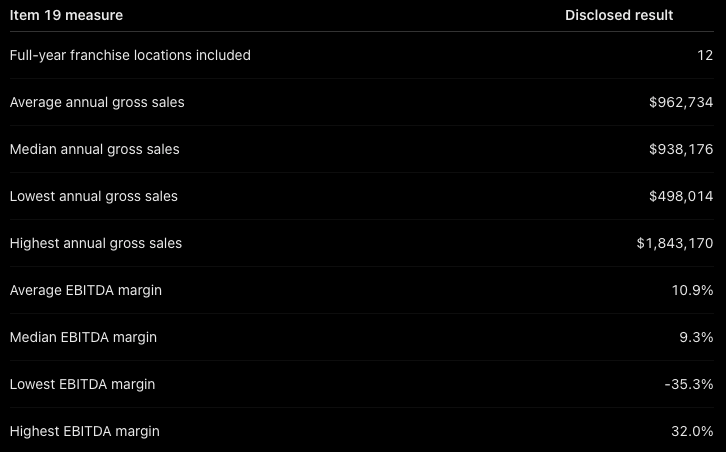
The same FDD estimates the investment to open a single club at $1,252,400 to $2,077,300. [6, PDF page 1]
Those figures give a buyer something concrete to evaluate. They also illustrate substantial variation in results and a limited full-year operating sample.
A 9.3% median EBITDA margin is not a 9.3% return on the amount invested. EBITDA is calculated before interest, taxes, depreciation, and amortization. It also does not measure the cash remaining after loan principal payments or capital expenditures. A buyer needs to determine what owner compensation and other costs are included in the underlying results.
The published sales and margin statistics also cannot safely be multiplied together to manufacture an “average franchisee profit.” The location with median sales need not be the location with the median margin, and multiplying averages does not establish average dollar EBITDA.
For a seven-figure investment, buyers need the underlying operating statements and a financing model that accounts for the cash demands of their particular location.
The earlier earnings claims still require scrutiny
The January 2024 company press release that helped prompt our original report promoted nearly $1.2 million in annual unit volume and a 42% EBITDA margin at top-performing clubs. [8]
The new Item 19 gives readers a different dataset: full-year franchisee results with a 10.9% average EBITDA margin and a 9.3% median.
It would be misleading to describe this as a measured decline from 42% to 9.3%. The figures concern different groups, periods, and potentially different expense treatment. What the comparison demonstrates is why a selected top-performing example should never substitute for evidence about the business a typical buyer expects to operate.
The presence of a financial performance representation in the 2026 FDD also does not establish that earlier representations were properly disclosed when made. That remains a separate question requiring the contemporaneous disclosure and sales materials. The bankruptcy filings themselves do not establish a finding of unlawful sales practices.
The warning about support was already in the disclosure
The 2026 FDD’s special-risk section expressly warns that the franchisor’s financial condition calls its ability to provide services and support into question. [6, PDF page 4]
Its audited statements for Picklr Franchise, Inc. show:
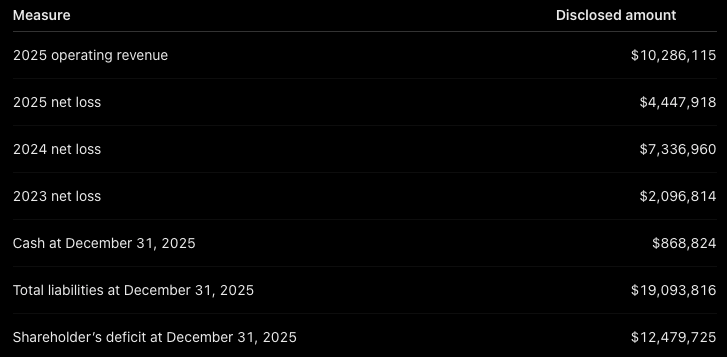
Source: 2026 FDD, Exhibit A, PDF pages 67–68. These are historical financial statements for the named franchisor entity, not consolidated results for every Picklr company or current bankruptcy balances.
The three annual net losses total approximately $13.88 million.
The liability total needs context: approximately $17.29 million consists of deferred revenue, combining current and noncurrent amounts. Deferred revenue should not be characterized as $17.29 million of bank debt or bills immediately payable in cash. Its accounting treatment and remaining performance obligations matter.
Even with that distinction, the recurring losses and explicit support warning are consequential. A franchise buyer is paying for an ongoing relationship. The provider’s capacity to fund that relationship belongs in the investment analysis alongside the projected economics of the club.
Open clubs, sold territories, and proven operations measure different things
Item 20 shows franchised outlets increasing from 22 to 56 during 2025. That was real expansion. It also reports five franchise transfers during the year, including three in Illinois, and one franchise location reacquired by the corporate affiliate. [6, PDF pages 53–56]
At year-end, the FDD listed 31 signed franchise agreements for outlets not yet open and 17 projected new franchised outlets for the next fiscal year. Those projections are not a count of actual 2026 openings. [6, PDF page 57]
With only 12 clubs qualifying for the full-year Item 19 sample, most of the franchised network remained too new to appear in that performance table.
A buyer should insist that any public “locations sold” figure be reconciled to its definition, geography, date, development rights, executed unit agreements, openings, and cancellations. Differences between these categories require explanation; they do not automatically prove that one count is false.
The more useful question is how many comparable locations have operated long enough to demonstrate sustainable cash flow after the owner’s actual costs.
Some operators are trying a different structure
In Goleta, California, owner Ted Guggenheim told the Santa Barbara News-Press that he was losing money under The Picklr franchise model. The facility announced a September transition to The Grove Pickleball, with lower prices and additional payment options. [9]
That provides a concrete example of an owner attempting to preserve a pickleball business while changing its brand and operating arrangement. It does not yet prove that the independent model will succeed.
Closures also require individual examination. Reporting about the Vestavia Hills, Alabama, location linked its September closure to the sale of the building. It should not simply be added to a bankruptcy-related failure count. [10]
The distinction is useful for the broader pickleball discussion: consumer interest, facility economics, and the value of a franchise relationship are separate questions. A busy sport can coexist with an unprofitable facility. A viable facility can also face an unsustainable combination of rent, financing, investment cost, and franchise obligations.
What this says about the pickleball franchise model
The Picklr’s difficulties do not establish that every indoor pickleball facility is unviable. They do challenge the assumption that enthusiasm for a sport provides sufficient evidence for a capital-intensive franchise investment.
A membership business must translate local interest into customers willing to pay enough, consistently enough, to carry its fixed commitments. Courts are finite. Peak-time demand does not ensure that weekday off-peak capacity earns comparable revenue. Under an unlimited-membership arrangement, additional visits by existing members can consume capacity without producing another membership payment. These are business-model considerations, not findings about utilization at any particular Picklr club.
The franchise relationship then needs to justify its own cost. Buyers should be able to identify what the brand, systems, purchasing arrangements, marketing, and operating support contribute to revenue or efficiency. When the support provider faces financial pressure, that value proposition becomes a current operating question.
The combination documented here is consequential: a young franchisee performance sample, seven-figure opening costs, an explicit support warning, losses at the corporate club operator, and a contested transaction intended to resolve an existing franchise dispute. Each addresses a different part of the investment. Together, they justify a much more demanding assessment than the growth narrative alone invites.
The question for a prospective owner is whether the particular location, lease, capital structure, and franchise relationship can produce sustainable cash flow. The popularity of pickleball cannot supply that answer.
What a prospective buyer should do with this information
These developments justify a pause before committing additional capital based on the earlier growth narrative. The next decision should be based on current, verifiable information:
Identify the entities behind the promises. Establish which company owes support, owns relevant assets, guarantees obligations, or is expected to buy a location, and verify its current status.
Request current disclosures and operating evidence. A May FDD and year-end 2025 outlet table cannot fully describe events that unfolded in September and October.
Model the proposed club’s cash needs. Include rent, labor, fees, debt service, owner compensation, maintenance, and a slower membership ramp. Obtain substantiation for earnings representations.
Speak with owners outside a curated reference list. Include recent openings, mature clubs, transferred locations, and former franchisees identified in the FDD.
Establish what support is available now. Request specific information about staffing, technology, marketing, training, and the resources funding those services during the restructuring.
The standard for proceeding should be evidence that the proposed investment can work under today’s conditions. A financing announcement or a growing location count cannot answer that on its own.
Our earlier report asked whether The Picklr’s sales story was supported by the disclosures. The court filings now put actual operating costs, cash balances, and disputed obligations beside that story.
The five franchise entities’ reported attempt to negotiate an exit is especially instructive. Signing an agreement did not conclude the matter. The proposed transaction became contested, the operators entered bankruptcy, and the intended corporate buyer subsequently did too.
For the next buyer, the standard should be evidence of a business that can support its costs and a franchise organization able to deliver its promises. For those already invested, the immediate issue is whether restructuring produces a workable operating relationship and a sustainable financial outcome.
The unresolved question is what The Picklr can now deliver to the people who funded its expansion, and what evidence supports asking the next owner to invest.
Continue the coverage: Read our original Picklr Reality Report and watch our podcast discussion on YouTube.
Sources
3 Strand Holdings LLC, public lead docket listing, including joint administration and October hearing entries.
Burlington PB LLC docket; Florida Middle court listings; BKalerts affiliated case listings.
Picklr, Inc., Chapter 11 docket listing, filed October 9, 2026.
Picklr Clubs, Inc., Chapter 11 docket listing, filed October 10, 2026.
IAPPF, “Update: The Picklr Crisis: What We Know Now”, October 3, 2026. Its statements that corporate bankruptcy was unverified were superseded by the October filings.
Picklr Franchise Inc., Franchise Disclosure Document, issued May 6, 2026. Source reviewed: “2026 The Picklr FDD,” 265 pages. Page references above are PDF file pages.
IAPPF, “Picklr files for Chapter 11, announces $4.5M investment commitment to restructure”, October 10, 2026.
The Picklr, January 4, 2024 growth announcement, PR Newswire.
Santa Barbara News-Press, Goleta rebranding report, September 11, 2026.
Bham Now, Vestavia Hills closure report, September 24, 2026.
Athletech News, “Pickleball Franchise The Picklr Cuts Staff, Is ‘Evaluating a Number of Options’”, September 25, 2026. Headline and publicly accessible summary reviewed.
Picklr, Inc., voluntary Chapter 11 petition and attachments, Northern District of Texas, case 26-34687-swe11, Document 1, filed October 9, 2026, 107 pages. Page references refer to the court-stamped document pages.
Picklr Clubs Inc., voluntary Chapter 11 petition and attachments, Northern District of Texas, case 26-34690-swe11, Document 1, filed October 10, 2026, 112 pages. Page references refer to the court-stamped document pages.
David Johnson, IAPPF, “5 Picklr Franchises Placed into Bankruptcy”. Source for the reported July 31 agreement, transaction consideration, and subsequent pause and termination request. This account predates the corporate filings; its earlier corporate-bankruptcy status is superseded by the petitions.
