
Cerca Trova Restaurant Group Holdings, Inc. and four affiliated entities filed Chapter 11 in Delaware on November 2, 2026. The group, which includes Out West Restaurant Group, operates 61 Outback Steakhouse restaurants across five western states. Its proposed path forward is a sale to its franchisor, subject to competing offers and court approval. [1][2]
But the more revealing story began years before the bankruptcy. According to the company’s CEO, financial covenant problems appeared by the end of 2018. Lender forbearance and franchisor concessions helped keep the restaurants operating. Meanwhile, senior secured obligations grew to approximately $319.9 million, including approximately $190.9 million in accrued and capitalized interest, fees and other obligations. [2]
For a prospective franchise buyer, the lesson is practical: the ability to keep operating does not establish that a business can repay its debt, maintain its assets and deliver a sustainable return to its owner.
Relevant FDD topics: Item 6, Other Fees; Item 7, Estimated Initial Investment; Item 17, Renewal, Termination, Transfer and Dispute Resolution; Item 19, Financial Performance Representations; and Item 20, Outlets and Franchisee Information. These are due-diligence connections, not findings about the contents of a particular Outback FDD. The case analysis below rests on the bankruptcy filings and transaction documents.
This report provides independent analysis of public records for educational purposes. It is not legal, financial or investment advice. Statements in declarations are attributed to their authors; proposed transactions and requested relief are distinguished from court orders. Figures are approximate where reported that way in the filings. Procedural status reflects documents reviewed through November 4, 2026.
Expansion came with debt and earnings did not keep up
The company’s predecessor, T-Bird Restaurant Group, began developing Outback restaurants in California in 1994. An affiliate of H.I.G. acquired the business in 2015 for approximately $112 million. In 2017, the group acquired 45 additional Outback restaurants from the franchisor for approximately $31.1 million, plus inventory and certain assumed liabilities. [2, ¶¶18–23]
By 2018, it operated 99 restaurants and generated more than $340 million in annual sales. Yet CEO David Goronkin states that, by the end of that year, the company could no longer meet financial covenants under its senior credit facility. [2, ¶¶3–4]
That chronology matters. COVID later inflicted a severe additional shock, but the financing problems were already present.
The acquisition price and loan structure depended on earnings that did not materialize as expected. Scale and substantial revenue did not prevent the mismatch.
Support bought time. The obligations continued to grow.
In December 2020, lenders agreed to forbear from exercising remedies and capitalize interest. The franchisor waived approximately $5.7 million in royalty and marketing fees and deferred approximately $18.1 million in additional obligations, according to Goronkin. [2, ¶6]
These accommodations were economically different. A waiver removed an obligation. A deferral postponed it. Capitalizing interest added financing costs to the outstanding balance.
The company could not repay or refinance its senior loans when they matured in April 2022. It continued operating under forbearance arrangements while default-rate interest accumulated. [2, ¶7]
At filing, Goronkin reported:
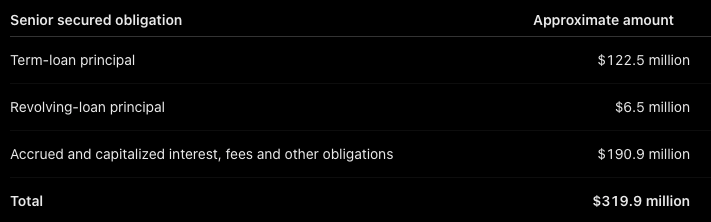
Source: CEO declaration, paragraph 43. The $190.9 million category is not exclusively interest. [2]
The declaration describes approximately $129 million in principal remaining broadly unchanged while total senior secured obligations grew from approximately $140 million in November 2020 to $319.9 million at filing. Fiscal 2025 interest expense alone was approximately $45.9 million—more than five times that year’s approximately $8.4 million in covenant EBITDA. [2, ¶¶7, 43, 53]
Forbearance can be valuable. It can preserve jobs, customer relationships and time to pursue a recovery. But an extension needs to be evaluated against what happens to the balance during the extension and what earnings will eventually repay it.
Restaurant economics were weakening too
It would be incomplete to describe this as a healthy operating business overwhelmed only by financing.
Goronkin reports declining guest traffic in fiscal 2023, 2024 and 2025, followed by another decline in the first half of 2026. Menu-price increases no longer offset traffic losses and changes in menu mix. Same-store sales fell in fiscal 2024 and 2025. [2, ¶49]
The company also reported higher labor, food, insurance, technology and maintenance costs. Restaurant-level EBITDA margin declined from approximately 8.8% in fiscal 2023 to approximately 5.0% for the twelve months ended August 23, 2026. [2, ¶¶50–53]
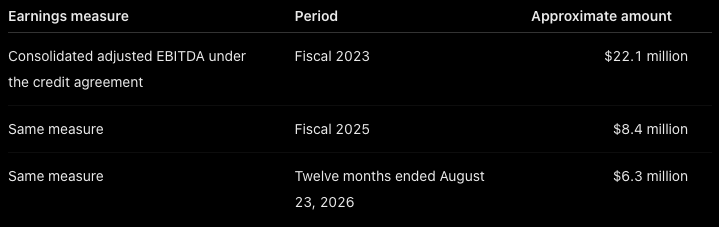
Source: CEO declaration, paragraph 53. These figures are management-reported and use the credit agreement’s calculation. [2]
The company separately reported approximately $321 million in revenue and $16.1 million in restaurant-level EBITDA for the twelve months ended August 23, 2026. Restaurant-level EBITDA and consolidated adjusted EBITDA are different measures. Neither should be presented as cash available for an owner to take home. [2, ¶26]
A buyer needs to understand what each earnings figure excludes, then account for corporate overhead, financing, taxes, required capital spending and other cash needs. An attractive revenue number cannot answer those questions.
What prospective buyers saw
The company’s investment banker provides another useful perspective.
Anish Gandhi of Brookwood Associates states that the firm contacted 177 potential buyers beginning in August 2026. Twenty signed confidentiality agreements, and three submitted letters of intent: two outside parties and Bloomin’ Brands, the franchisor’s parent. [3, ¶¶8–10]
According to Gandhi, feedback from parties that declined to proceed included concerns about negative same-store sales, low margins, deferred maintenance capital expenditures, underperforming restaurants, California concentration and limited opportunities to expand within the Outback system. [3, ¶13]
Those concerns connect the income statement to the condition of the assets. A business may report positive earnings while still requiring substantial spending to maintain the restaurants that produce them.
Gandhi states that both outside proposals offered less cash and included less favorable cost allocations or contingencies. Their prices are not disclosed in his declaration. The debtors and Brookwood judged the franchisor’s proposal to offer the best available value and greater certainty of closing. That is their assessment—not a completed auction result. [3, ¶¶11–16]
Ten restaurants had already closed
The 61 operating restaurants should not be confused with the ten locations closed shortly before filing.
The debtors’ lease-rejection motion says those ten restaurants ceased operating between October 11 and October 25, 2026. They are excluded from the proposed sale. The company seeks to reject their leases and abandon remaining property, reporting approximately $164,000 in combined monthly base rent before other occupancy charges. [4, ¶¶7–10]
The motion addresses already-closed locations. It does not establish that ten of the remaining 61 restaurants are now scheduled to close. Nor does submitting a proposed rejection order establish that the court has granted it.
The proposed buyer is also the franchisor and bankruptcy lender
Outback Steakhouse of Florida, LLC is the proposed stalking-horse purchaser. A stalking-horse agreement establishes an opening transaction against which competing offers can be evaluated; it does not complete the sale.
The agreement provides for $26.3 million in base cash consideration, an additional amount if specified assumed liabilities fall below $6.1 million, assumption of defined obligations, and payment of applicable cure costs subject to the agreement’s limits. Outstanding bankruptcy-financing obligations reduce the cash delivered at closing. [5, §§3.1–3.3]
The CEO also reports approximately $13.9 million in deferred franchisor obligations at filing. The contemplated closing includes releases of franchisor claims under the relevant agreements. Those releases are conditional; the deferred balance has not already been forgiven merely because the bankruptcy was filed. [2, ¶46; 5, §8.13]
These terms make “61 restaurants for $26.3 million” an incomplete description of the economics. Assumed liabilities, cure payments, adjustments and releases matter alongside the headline cash amount.
The franchisor’s overlapping roles also deserve attention. It is a creditor, proposed buyer and bankruptcy lender, while affiliates serve as landlords or sublandlords at certain locations. Gandhi states that it holds no equity in the debtors and has no board representative. He describes negotiated protections for competing bidders, including approval standards and deadlines and waivers of rights of first refusal. [3, ¶¶17–19]
Those facts should be considered together. Multiple roles create issues to examine; they do not, by themselves, establish an improper process.
Financing keeps the sale process moving
The November 4 interim order authorizes up to $2.5 million in interim advances within a proposed $5.5 million financing facility. Advances bear no interest, but the financing includes a $50,000 commitment fee and reimbursable expenses. [6, ¶¶2–3]
Brickley’s declaration explains that early payments to vendors, insurance premiums, utility deposits and professional-fee reserves create concentrated cash demands. The budget forecasts approximately $4.5 million in borrowing. Those are projected draws, not amounts already advanced. [7, ¶¶7–12]
Brookwood did not separately solicit bankruptcy financing. Gandhi states that it concluded such a process would be futile given the existing liens, lack of material unencumbered assets and lenders’ limited consent to being displaced in priority. We therefore cannot characterize this as a competitive financing auction won by the franchisor. [8, ¶¶9–14]
The purpose of this financing is to preserve operations through a sale. It does not demonstrate that the existing business could repay its accumulated debt through ordinary operations.
What the court has, and has not, approved
As of the documents reviewed through November 4, the court has entered an interim financing order. The sale has not been approved in the materials reviewed.
Document 58 sets a November 16 objection deadline and a November 23 hearing on bidding procedures. It does not approve the bidding procedures or the acquisition. December auction and sale dates described in the initial declarations remain proposed process dates unless established by a subsequent order. [6][9]
What a buyer should do differently
The useful response to this bankruptcy is to ask more precise questions before committing capital:
Reconcile earnings to cash. Obtain the definitions behind every EBITDA figure. Identify excluded overhead and the cash required for debt payments, owner compensation, taxes, repairs and reinvestment.
Test the acquisition price against weaker results. Examine whether the proposed debt remains serviceable if traffic falls, margins shrink or refinancing is unavailable at maturity. Do not rely on expansion to repair weak first-unit economics.
Separate relief by type. Identify what is waived, what is deferred, what accrues interest and what triggers repayment. A smaller current payment can coexist with a larger eventual obligation.
Inspect deferred capital needs. Review equipment condition, maintenance history, required remodels and deadlines. Include those costs in the acquisition analysis.
Study exits and transfers. Review lender consents, franchisee approval requirements, leases, guarantees and the consequences of a sale or closure. Obtain the actual documents governing those rights.
For an existing owner considering a forbearance agreement, ask advisers to show both the projected debt balance and the projected cash available to repay it at the end of the extension. The extension itself is not the recovery plan.
The Franchise Reality Check
These filings describe years of support, continued operations, declining earnings and growing obligations. They also describe a proposed transaction intended to preserve the remaining restaurants under a different ownership arrangement.
A business can keep serving customers while the financial position of its owner continues to deteriorate.
Before buying a franchise—or borrowing to expand one—establish whether its sustainable cash generation can support the purchase price, financing and reinvestment it requires. If that calculation depends on repeated concessions, another refinancing or a future buyer paying more, those assumptions need evidence before they become your obligations.
Franchise Facts, Not Sales Pitches.
Sources
All court documents below are from In re Cerca Trova Restaurant Group Holdings, Inc., et al., Case No. 26-11749-CTG, U.S. Bankruptcy Court for the District of Delaware. References identify filed-page numbers or numbered paragraphs; declarations reflect the declarants’ statements and opinions.
Document 1, Voluntary Petition, filed November 2, 2026, including Annex 1 identifying the five debtors.
Document 4, Declaration of David Goronkin in Support of Chapter 11 Petitions and First Day Relief, filed November 2, 2026, particularly ¶¶1–11, 18–26, 34–36, 43–59 and 125–135.
Document 18, Declaration of Anish Gandhi supporting the sale/bidding-procedures motion, filed November 2, 2026, particularly ¶¶8–26.
Document 20, First Omnibus Motion to Reject Certain Unexpired Leases and Abandon Remaining Personal Property, filed November 2, 2026, including proposed order and location schedule.
Document 17-2, Exhibit B to the sale motion: executed Asset Purchase Agreement dated November 1, 2026, particularly §§3.1–3.3 and 8.13. See also Document 17, sale motion, and Document 17-1, proposed orders and procedures.
Document 51, Interim Order Authorizing Post-Petition Financing, Use of Cash Collateral and Adequate Protection, entered November 4, 2026; see also Document 51-1, budget, and Document 51-2, milestones.
Document 16, Declaration of Douglas J. Brickley in Support of the DIP Financing and Cash Collateral Motion, filed November 2, 2026, particularly ¶¶7–15.
Document 15, Declaration of Anish Gandhi in Support of the DIP Financing and Cash Collateral Motion, filed November 2, 2026, particularly ¶¶9–17.
Document 58, Order Setting an Objection Deadline and Scheduling a Hearing on Bidding Procedures Relief, entered November 4, 2026, ¶¶2–3.
