
Meritage’s bankruptcy has moved beyond unpaid franchise fees. Court filings reveal a lender-backed closure schedule, Wendy’s proposal to keep selected restaurants operating, and a dispute over whether an offer to cover losses adequately protected the franchisee’s estate.
Relevant FDD Topics: Item 6: Other Fees; Item 10: Financing; Item 17: Renewal, Termination, Transfer, and Dispute Resolution; Item 19: Financial Performance Representations; Item 20: Outlets and Franchisee Information. Related documents: franchise agreements, leases, guarantees, collateral assignments, lender agreements, and bankruptcy orders. These are due-diligence connections; this report does not represent a new review of every provision in Wendy’s FDD.
Read the original report: Wendy’s Was Owed Nearly $25 Million Before One of Its Largest Franchisees Filed Bankruptcy
This report provides educational commentary based on the identified court filings reviewed for this article, including documents filed through October 23, 2026. It is not a complete account of subsequent docket activity. Allegations, sworn statements, proposed arrangements, and disputed claims are distinguished from court orders. Interpretations and conclusions are the opinions of Franchise Reality Check™. This is not legal, financial, or investment advice. Franchise Reality Check™ is not affiliated with Wendy’s, Meritage Hospitality Group, or their affiliates.
The bankruptcy raised a second question: who decides which losses stop first?
Our earlier report examined what a prospective buyer could have discovered before Meritage entered Chapter 11: deferred franchise fees, defaults, financial accommodations, shrinking restaurant portfolios, and weakening economics. The follow-up concerns what happened when the operator tried to reduce those losses.
Closing an unprofitable restaurant sounds straightforward. Identify the location draining cash, stop operating, and preserve what remains for the rest of the business.
Meritage’s filings show why that decision can become considerably more complicated. Its lender-backed cash-collateral arrangement required closures. Wendy’s franchisor, Quality Is Our Recipe, LLC, or QIOR, wanted selected restaurants kept open while it evaluated their future. Meritage argued that changing the closure list would prolong deeper losses, disrupt preparations already underway, and leave the estate relying on a disputed reimbursement arrangement. [1–4]
The disagreement was not simply whether losing restaurants should close. It concerned which restaurants, on what schedule, with whose financial support, and under which agreements.
The closure schedule was a condition of access to cash
On September 23, the bankruptcy court entered an interim order permitting the specified City National Bank borrower group to use cash collateral under a budget and other conditions. Paragraph 20(a) required at least 30 EBITDA-negative stores to shut down in four groups: at least five by September 25, five by October 2, ten by October 9, and ten by October 16, unless the administrative agent agreed in writing to modify the schedule. [1, ¶20(a)]
The order described these milestones as additional adequate protection in exchange for use of cash collateral. It also preserved the administrative agent’s right to request additional closures as a condition of continued use.
That is an important ownership distinction. The decision to stop restaurant losses was connected to the conditions under which the business could continue spending cash. It was not an isolated operating choice.
Meritage’s chief restructuring officer, Kevin Cleary, described a broader 41-store closure program in his October 9 declaration. He reported approximately $4.25 million in aggregate trailing-twelve-month store-level EBITDA losses for those locations. That 41-store program and the order’s minimum 30-store requirement are different measures and should not be added together. The declaration described scheduled closures, not proof that every location had already closed. [3, ¶¶3–6]
Wendy’s proposed a different list
For October 9, Meritage selected ten restaurants for closure. QIOR sought to substitute seven other restaurants while leaving three locations on both lists. Its stated purpose was to gain time to evaluate whether it wanted to acquire or assume responsibility for continued operations at selected restaurants. [2, ¶¶5–15]
QIOR argued that continued operation could preserve jobs and going-concern value and reduce potential rejection damages and other claims. It offered to cover qualifying operating losses during the evaluation period and contended that the financial difference between the two lists was small relative to the potential upside.
That position deserves to be presented fairly. Closing a restaurant can destroy value that might otherwise be preserved through a transfer or another operating arrangement. QIOR argued that its proposal would protect the estate financially while allowing that possibility to be evaluated.
But its filing also expressly disclaimed an obligation to acquire, assume, or operate any restaurant, apart from its stated undertaking concerning qualifying losses. [2, ¶26]
An evaluation period and a completed transaction are different things. The operator still has to determine what it must spend while the evaluation takes place, which costs will be reimbursed, and what happens if no acquisition follows.
The financial comparison did not answer the whole question
Cleary’s declaration supplied the underlying historical loss comparison:
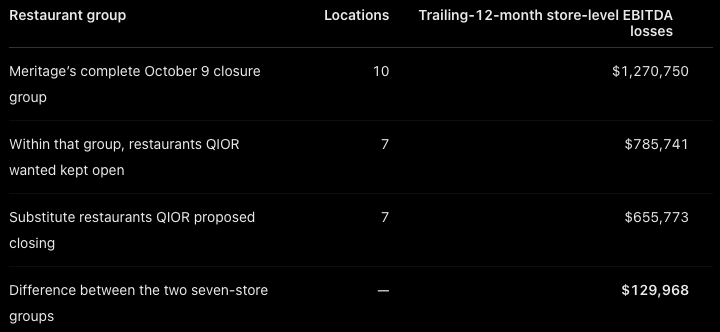
Source: Cleary declaration, paragraphs 7–11; Meritage response, paragraph 10. QIOR’s own exhibit presents rounded figures consistent with the approximately $130,000 annual difference. These are historical store-level results, not projected cash savings or total closure costs. [2, Exhibit A; 3; 4]
The seven restaurants Meritage proposed closing had larger combined historical losses than the seven substitutes. QIOR offered to cover the financial difference associated with its proposal. The question therefore became whether that offer adequately addressed the costs and risks of changing the plan.
This is where an EBITDA comparison reaches its limits. It does not, by itself, establish the cash needed to reverse a shutdown, move inventory and equipment, retain employees, change vendor arrangements, or address continuing lease obligations. Nor does a trailing-year result establish what a particular restaurant will lose over the next several weeks.
The filings also use different descriptions of the approximately $11,000 figure: QIOR’s objection calls it monthly, its exhibit labels an average per period, and Cleary discusses the company’s four-week accounting periods. The clearest comparison is the approximately $130,000 trailing-year difference. It should not be converted into a precise payment schedule without the actual agreement. [2, ¶15 and Exhibit A; 3, ¶11 and footnote 3]
“We will cover the losses” still leaves terms to negotiate
Cleary stated that the proposed support was not funded, escrowed, or secured. He also said it did not cover the costs of reversing closure preparations, rescheduling employees and vendors, or reopening landlord negotiations. Those statements explain Meritage’s position; they are not findings that QIOR would fail to pay. [3, ¶14]
Meritage’s response focused on the language of the undertaking. QIOR’s objection referred in different places to potential losses, actual reasonable documented net operating losses, and reasonable undisputed operating losses. Meritage argued that these qualifications could produce another disagreement about reimbursement. [4, ¶18]
The operational timing mattered as well. Cleary said QIOR proposed the seven-store substitution on October 7, two days before the scheduled closures. Supply cancellations, inventory and equipment removal, employee notices, utility shutoffs, and online-ordering changes were already in process. He also described an earlier adjustment accommodating QIOR’s request to delay four closures. [3, ¶¶8–10, 15]
For an owner evaluating a support proposal, the practical questions extend well beyond the headline amount. Which expenses qualify? Is support paid in advance or reimbursed later? Who approves the calculation? Are transition costs included? How long does the commitment last? What happens if the parties disagree or the proposed buyer walks away?
Those details determine whether assistance provides usable cash when the business needs it.
One restaurant belonged to a different lender’s collateral pool
One of QIOR’s proposed substitutes was the King, North Carolina, location operated by Uncommon Hospitality. Cleary identified it as belonging to Old National Bank’s collateral pool rather than the City National group, with a separate cash-collateral arrangement. Meritage argued that substituting it treated the two lender groups’ collateral and budgets as interchangeable. [3, ¶16; 4, ¶20]
That detail is easy to miss in a portfolio-wide comparison. Two lists can contain the same number of stores and similar aggregate losses while affecting different borrowers, lenders, and pools of collateral.
For multi-unit buyers, the lesson is to understand how the portfolio is financed at the entity and asset level. The relevant question is not only how much debt the organization carries. It is which agreements govern which stores, and how a closure, sale, or transfer affects those arrangements.
The franchise rights themselves were also disputed
A separate adversary proceeding concerns whether QIOR effectively terminated Meritage’s franchise agreements before the September 17 bankruptcy filing. Meritage challenges the termination based on notice, cure rights, lender protections, and other arguments. QIOR maintains that the agreements were terminated and denies the central allegations. [6–7]
QIOR’s earlier first-day objection also distinguished continued restaurant operations from Meritage’s continued franchise ownership. It said it would consider a temporary license to facilitate a transition to Wendy’s or other franchisees while maintaining that Meritage’s original rights had ended. [5, ¶¶9–15]
The lender dispute adds another layer. City National and Old National sought to intervene, alleging violations of their own contractual notice and cure rights. City National also identified a separate Sharing Agreement that it contended restricted QIOR’s remedies. These are the lenders’ allegations about negotiated rights and collateral protection; the intervention motion itself does not establish that those allegations prevailed. [8, pp. 2–5]
Taken together, the documents show why preserving restaurant operations and preserving the existing owner’s contractual position are not necessarily the same objective. Restaurants, franchise rights, debt, and potential transfers are intertwined, but they remain distinct issues.
A rejection order did not settle the termination dispute
On October 23, the court entered Document 323, resolving Meritage’s first omnibus rejection motion concerning five locations. Its schedules identify five leases and five corresponding franchise agreements, with rejection effective September 25. This is a specific five-location order, not evidence that a larger group of additional closures had been completed. [9–10]
The order expressly states that it does not determine the date, validity, or effectiveness of the alleged franchise-agreement termination. It also preserves rights relating to claims and guarantees, including counterparties’ rights against guarantors. [10, ¶¶5, 8–10]
That matters to the broader lesson. An order addressing particular agreements can facilitate restructuring while leaving other disputes unresolved. It should not be presented as a comprehensive release from all costs associated with leaving a location, or as a ruling that Meritage won the separate termination case.
The reviewed record establishes the initial closure requirement, the competing proposals, and this five-location rejection order. It does not establish the final disposition of every closure objection or the adversary action. The analysis here concerns the documented decisions and disputed terms, not an assumed ultimate winner.
What a prospective buyer should do with this information
Meritage’s circumstances do not establish that every Wendy’s franchisee faces the same economics or financing restrictions. They do show why exit planning should address the agreements together, rather than treating closure as the simple reversal of opening.
Map the agreements that govern an exit. Have independent counsel review the franchise agreement, lease, guarantees, loan documents, and relevant collateral assignments together. Identify notice requirements, consent provisions, cure rights, and obligations that may continue after operations stop.
Model continuing, selling, and closing separately. Distinguish expenses that stop from expenses that remain, one-time transition costs, debt obligations, and potential claims. Do not treat historical EBITDA losses as a complete estimate of cash saved by closing.
Put support proposals in writing. Establish the responsible entity, covered expenses, payment timing, duration, documentation requirements, and process for resolving disagreements. Evaluate what funds the operator must advance before reimbursement.
Examine the financing structure store by store. For a multi-unit acquisition, identify the borrowing entities and collateral pools. Understand how a proposed sale or closure affects each arrangement.
Investigate actual exits. Speak with former franchisees and operators who sold, transferred, or closed locations. Ask about time, cost, consent, and continuing obligations—not simply whether an exit was ultimately possible.
The Franchise Reality Check
The useful question in this dispute is whether a proposed solution protects the business that must carry it out.
QIOR argued that keeping selected restaurants operating could preserve value and offered financial support. Meritage argued that the proposal left meaningful costs and risks unresolved while requiring deeper-loss restaurants to remain open longer. The lender-backed order imposed its own closure timetable. Each position needs to be understood on its terms.
For a prospective franchisee, the conclusion is practical: the ability to fund an opening does not establish the ability to fund a difficult transition. Before investing, understand who can influence the exit, which obligations survive it, and how any promised assistance becomes cash the business can actually use.
The franchisee’s operating statement may show the loss. The decision about how to stop it can involve far more than the franchisee.
Sources
Court filings below were obtained through PACER and supplied for review. Main case: In re Meritage Hospitality Group Inc., et al., U.S. Bankruptcy Court for the Western District of Michigan, No. 26-02947-jwb. Adversary proceeding: 26-80079-jwb. References identify court-stamped docket numbers; upload filenames may differ. PACER.
Main case, Document 103, Interim Order (I) Authorizing Interim Use of Cash Collateral, (II) Granting Adequate Protection and Related Relief and (III) Scheduling a Final Hearing, September 23, 2026, particularly ¶20(a).
Main case, Document 172, QIOR’s Objection to Entry of a Final Cash Collateral Order and to the Immediate Closure of Disputed Restaurant Locations, October 7, 2026, particularly ¶¶5–16, 22–26 and Exhibit A. Supplied filename: “Wendy’s Objection #176.pdf”; the court header confirms Document 172.
Main case, Document 207, Declaration of Kevin Cleary in Support of Debtors’ Response in Opposition to QIOR’s Objection, October 9, 2026, particularly ¶¶3–19.
Main case, Document 206, Debtors’ Response in Opposition to QIOR’s Objection to Entry of a Final Cash Collateral Order and to the Immediate Closure of Disputed Restaurant Locations, October 9, 2026, particularly ¶¶9–22.
Main case, Document 71, QIOR’s Objection to Debtors’ First Day Motions, September 21, 2026, particularly ¶¶9–15.
Adversary proceeding, Document 3, amended Complaint for Declaratory Judgment and Injunctive Relief, October 1, 2026, particularly ¶¶34–61 and prayer for relief.
Adversary proceeding, Document 7, QIOR and The Wendy’s Company’s Answer, October 2, 2026, particularly responses to ¶¶23, 34, 38–51 and affirmative defenses.
Adversary proceeding, Document 16, Unopposed Joint Motion to Intervene by City National Bank and Old National Bank and Memorandum in Support, October 12, 2026, pp. 2–5.
Main case, Document 121, Debtors’ First Omnibus Motion Authorizing Rejection of Certain Unexpired Leases and Executory Contracts, September 25, 2026, particularly ¶¶1, 9–10.
Main case, Document 323 and attachment 323-1, Order Authorizing Rejection of Certain Unexpired Leases and Executory Contracts, October 23, 2026, particularly ¶¶2, 5, 8–10 and Schedules 1–2.
