
Sparkle Grooming Co. Franchise Brand Brief: Hundreds of Licenses, but How Much Operating Proof?
High-level review of the 2024, 2025 and 2026 Unit Franchise Disclosure Documents and the 2026 Regional Developer FDD
Sparkle At a Glance
Brand: Sparkle Grooming Co.
Industry: Dog grooming, hygiene and routine pet care
Franchisor: Sparkle Franchising LLC
Franchising Since: March 2024
FDDs Reviewed: 2024, 2025 and 2026 Unit FDDs; 2026 Regional Developer FDD
Relevant FDD Topics: Special Risks; Items 3–8, 11, 12, 17, 19, 20 and 21; state addenda
Estimated Initial Investment: $238,750 to $485,250 for one salon
Initial Franchise Fee: $39,000 for the first salon; $29,000 for additional salons
Overall Risk Signal: 🟠 Orange
Primary Concern: Development commitments substantially exceed the operating history available to evaluate the model, while the FDD explicitly questions the franchisor's financial ability to provide services and support.
This Franchise Brief is provided for informational and educational purposes only. It is not legal, financial, tax or investment advice, nor a recommendation to purchase or avoid any franchise. Information may change. Prospective franchisees should review the current FDD, conduct independent diligence, speak with current and former franchisees, and consult qualified professional advisors. Ratings and conclusions reflect Franchise Reality Check™’s independent analysis and do not guarantee outcomes.
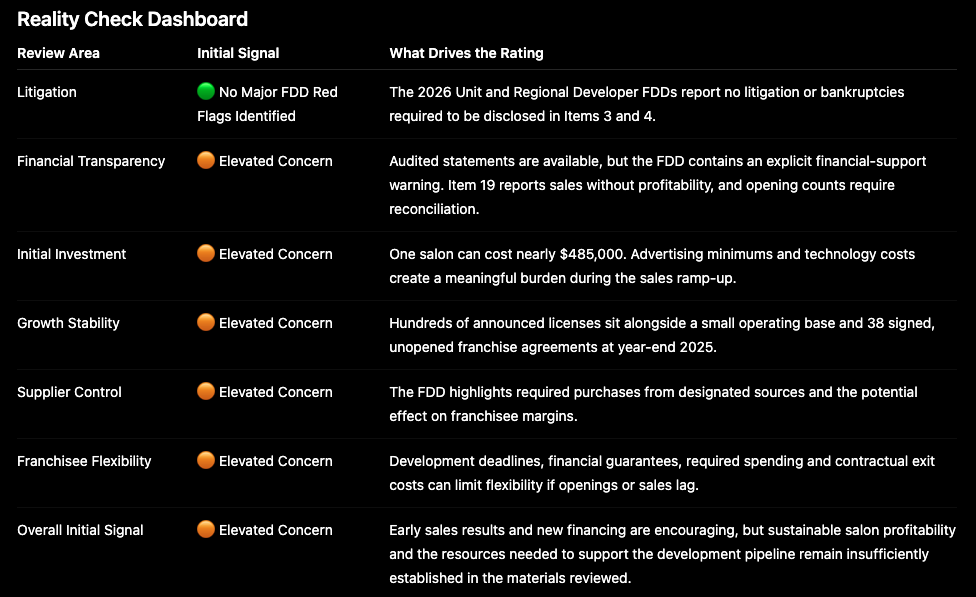
These signals describe issues identified in the materials reviewed. They are not predictions of whether an individual franchise investment will succeed or fail.
Why This Report Matters
Sparkle has an appealing proposition: recurring memberships, routine dog care and a relatively compact salon format. Its early operating results show that customers are buying the services and that some locations have built substantial membership bases.
The brand has also attracted attention for its franchise development activity. In its growth-financing announcement, Sparkle reported more than 600 licenses awarded in 24 months, $6 million in financing led by Companion Fund, and 10 operating salons. It expected at least 20 operating locations by the end of 2026 and more than 30 additional openings in 2027.
Those figures measure different things. License awards describe development commitments. Operating salons provide evidence about delivering the service, retaining members and paying the bills. Sparkle’s announcement distinguishes the two, and buyers should preserve that distinction when evaluating its scale.
The FDD adds another issue: an express warning about the franchisor’s financial ability to support franchisees. The new financing is relevant, but the available audited statements predate it. Buyers need to evaluate both the developing salon model and the resources available to support its expansion.
🟠 The Development Pipeline Is Much Larger Than the Operating Base
The Unit FDD’s Item 20 reports the following operating footprint:
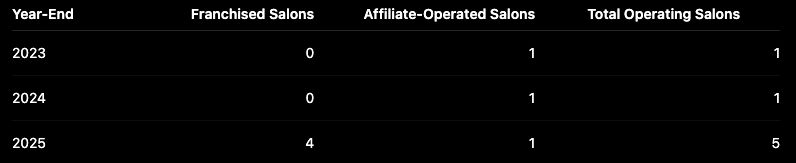
The 2025 FDD listed 11 signed franchise agreements for unopened salons and projected nine franchised openings during 2025. The following FDD reported four openings for that year. At December 31, 2025, signed agreements for unopened salons had increased to 38, with 22 new franchised openings projected for 2026.
A projection is not a guarantee, and these figures alone do not establish why openings differed from expectations. They do make opening execution an important diligence topic. The 2026 FDD itself highlights unopened franchises as a special risk and warns that buyers may experience opening delays.
The operating disclosures also need a written reconciliation. Item 20 reports two franchised salons in Colorado at year-end 2025. Item 19 identifies Highlands Ranch as a 2025 opening but Boulder as a 2026 opening, with its sales table starting in February 2026. Its other identified 2025 franchised openings are Scottsdale Shea and Arcadia in Arizona. The statements do not clearly explain the fourth franchised salon reported for year-end 2025.
This discrepancy does not prove that the development claims are false. It means buyers should request a dated, location-by-location schedule distinguishing agreements signed, salons under construction and salons actually operating.
Signal: 🟠 Orange
🟠 Regional Development Rights Need to Be Counted Separately
Sparkle offers individual salon franchises, multi-unit development agreements and a separate Regional Developer opportunity. These are economically different commitments.
A Regional Developer recruits and supports franchisees within a development area. Under the 2026 RD FDD, the development fee ranges from $97,500 to $975,000 for areas contemplated to support 10 to 100 potential salons. The formula is 25% of the then-current initial franchise fee multiplied by the number of potential salons. At a $39,000 initial fee, that is $9,750 per potential salon.
Paying for a development area does not mean that every contemplated salon already has a separate operator, signed lease, financing or opening date. Regional Developers may also own salons under separate franchise agreements.
RD Item 20 reports growth from 11 Regional Developer outlets in 2024 to 25 in 2025. These are neither salon counts nor necessarily distinct owners. The FDD says one developer operating in Arkansas, Missouri and Oklahoma is counted separately in each state.
The reviewed FDDs do not provide a reconciliation of the later public license count across individual franchise agreements, multi-unit development rights and regional allocations. Buyers should ask which categories are included and how overlapping rights are counted. The difference in reporting dates also matters: year-end 2025 disclosures cannot independently verify awards announced during 2026.
Signal: 🟠 Orange
🟡 Early Sales Results Are Encouraging, but Profitability Is Undisclosed
The 2026 Item 19 reports monthly appointments, memberships and net sales for eight salons through March 2026: one affiliate-owned salon and seven franchised salons.
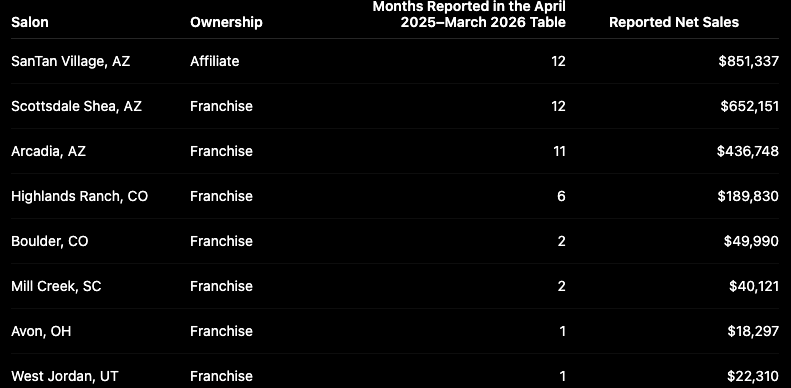
The reported totals cover different operating periods. They should not be averaged into an annual franchise revenue figure or treated as comparable annual results.
Scottsdale Shea provides a useful early full-year franchise observation. Several other locations show increasing monthly sales as they develop. Those are positive signals, but only one franchised salon supplies a complete 12-month result in this table.
Item 19 does not disclose salon operating profit, payroll, occupancy expense, owner compensation or debt service. Consequently, the sales results cannot establish how much cash owners keep or how long they take to recover their investment.
The affiliate salon also has a different configuration: 982 square feet with four tables/tubs, versus approximately 1,000 to 1,400 square feet and six to eight tables/tubs for the other salons. Its revenue should not be translated into expected franchise margins without comparing staffing, capacity and occupancy costs.
The RD FDD repeats salon results. It does not provide a Regional Developer profit-and-loss history. Potential RD returns also depend on franchise recruitment, actual openings, fee collections and the cost of delivering support.
Signal: 🟡 Yellow
🟠 Required Spending Can Weigh Heavily During the Ramp-Up
The estimated investment for one salon increased from $235,795–$445,250 in the 2024 FDD to $238,750–$485,250 in 2026. The latest estimate includes $40,000 to $60,000 in additional funds for the first three months and excludes owner compensation from that allowance. Three months of additional funds does not establish the amount needed to reach profitability.
The recurring requirements include:
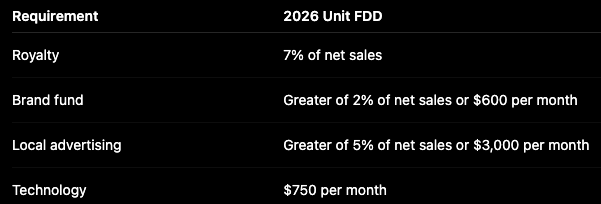
At an illustrative $30,000 in monthly net sales, those four requirements total $6,450, or 21.5% of sales, before labor, rent, supplies, insurance and other expenses. Local advertising is required spending and is not necessarily revenue received by the franchisor. This illustration is not a sales forecast or a complete operating budget.
Minimum spending makes the effective percentage burden higher when sales are low. Buyers should obtain actual monthly salon financial statements and build a cash plan that extends through the observed break-even period.
Multi-unit buyers also need to separate prepaid development fees from construction and operating capital for each future salon. The disclosed $58,000 to $145,000 development fee for two to five additional salon rights does not fund those salons’ buildouts.
Signal: 🟠 Orange
🟠 Item 21 Shows Substantial Losses and Reliance on Development Activity
The Unit and RD FDDs contain financial statements for the same franchisor, Sparkle Franchising LLC. Their revenues should not be added together.
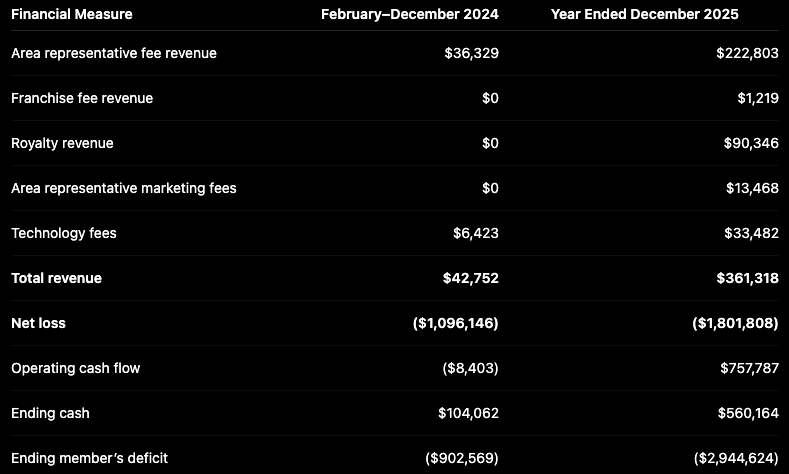
The franchisor generated positive operating cash flow in 2025 despite its loss. Growth in deferred fees was a major contributor: deferred area representative fees increased by approximately $2.41 million and deferred franchise fees increased by approximately $914,000.
At year-end, the balance sheet carried $3,443,812 in deferred area representative fees and $1,049,875 in deferred franchise fees, a combined $4,493,687. These balances help explain why recognized revenue is much smaller than development-related activity. Initial fees are recognized over the agreement term rather than entirely when an agreement is signed or a payment is received.
Accordingly, the $1,219 franchise-fee revenue figure does not mean Sparkle sold only $1,219 of franchise rights. Conversely, the deferred balances cannot verify an exact license count. Pricing, discounts, contract types, timing and receivables must be reconciled to an agreement register.
The member’s deficit also requires context. Most reported liabilities are deferred fees associated with future performance obligations, rather than conventional borrowing. Current assets exceeded current liabilities at year-end 2025. It would be inaccurate to describe every dollar of the deficit as overdue debt or to conclude from the deficit alone that the company cannot pay its bills.
The substantive concern is that recognized recurring revenue from operating salons remains small relative to the franchisor’s expenses, while development fees help finance the expanding organization. Buyers need to understand how support will be funded if new awards slow or openings take longer than planned.
Signal: 🟠 Orange
🟠 The FDD Explicitly Questions the Ability to Provide Support
The financial-support concern is stated directly in the disclosure documents. The 2026 Unit FDD’s Special Risks section says:
“The franchisor’s financial condition, as reflected in its financial statements (see Item 21), calls into question the franchisor’s financial ability to provide services and support to you.”
The 2026 Regional Developer FDD contains the same warning. The 2025 Unit FDD also included a financial-condition warning.
The California addendum goes further. It states that the department determined the franchisor had not demonstrated adequate capitalization and/or must rely on franchise fees to fund operations. It imposes deferral of initial fees until pre-opening obligations are completed and the franchise opens. For California development agreements, fees attributable to a particular unit are deferred until that unit opens.
These are material disclosures about the franchisor’s support capacity and fee collection arrangements. Their application depends on the relevant state provisions.
The auditor’s report should be characterized accurately. CliftonLarsonAllen issued an unmodified opinion on the financial statements. The report does not contain a separate substantial-doubt going-concern conclusion. Its standard description of management’s and the auditor’s going-concern responsibilities should not be mistaken for such a finding. An unmodified audit opinion, however, does not erase the FDD’s support warning or certify that the franchisor has enough resources for its expansion plans.
The later financing announcement could materially improve available resources. The reviewed materials do not establish the recipient entity, net proceeds available to Sparkle Franchising LLC, financing obligations or the updated support budget. Nor do they establish that the disclosed state fee-deferral conditions have been removed. Updated financial statements and a written explanation of the funding structure are needed to assess what has changed.
Signal: 🟠 Orange
🟠 Buyers Should Establish Who Will Deliver Support
The regional structure adds another party to the support relationship. The RD agreement assigns Regional Developers responsibilities for franchisee training, opening assistance and ongoing services, including inspections at least quarterly.
The agreement also provides compensation tied to initial franchise fees and salon royalties, subject to performance and collection conditions. That structure can create local support capacity. Its effectiveness depends on each developer’s staffing, experience, financial resources and geographic workload.
Prospective salon owners should identify the actual developer serving their market, meet the people who will provide support and ask what happens if the developer stops performing or leaves the system. They should also establish which responsibilities remain with the franchisor and which assistance is included in their fees.
Regional Developer buyers face a separate commitment: recruiting operators and supporting their salons under a development schedule. Purchasing an area does not establish demand from qualified franchise buyers or the profitability of supporting that area.
Signal: 🟠 Orange
🟠 Supplier Requirements and Contract Terms Limit Flexibility
The Unit FDD expressly highlights supplier control as a special risk. It says all or nearly all necessary inventory or supplies must come from the franchisor, affiliates or designated suppliers at their prices, which may be higher than alternative sources.
Required computer systems can also change. Item 11 states that the agreement does not limit the frequency or cost of required system changes, upgrades or updates. Buyers should understand the full technology budget beyond the monthly fee.
Other disclosed obligations deserve attention before committing capital. The special-risk section highlights spousal liability and minimum advertising payments. Item 6 lists a $2,500 monthly development deadline extension fee and an early termination fee equal to 50% of the initial franchise fee, plus the franchisor’s attorneys’ fees and costs, subject to the applicable agreement and state provisions.
These terms matter if a buyer needs to slow expansion or exit after a disappointing ramp-up. They should be evaluated alongside the actual franchise agreement, development schedule and state addenda.
Signal: 🟠 Orange
The Reality Check
Sparkle has evidence of customer demand, growing memberships at several salons and an expanding development pipeline. Its new financing is a potentially meaningful improvement in the resources available to build the system.
The operating evidence remains young. The 2026 Item 19 contains only one full 12-month franchise result and no salon profitability disclosure. The franchisor reported a $1.80 million loss for 2025, while development-related deferred fees helped produce positive operating cash flow. The FDD expressly questions financial support capacity and discloses state fee-deferral requirements.
The central diligence question is whether Sparkle can convert its development commitments into profitable, well-supported operating salons, and whether an individual buyer has enough capital to reach that point. The license headline alone cannot answer it.
Overall Risk Signal: 🟠 Orange
The orange rating reflects elevated concern arising from the short operating history, limited profit evidence, development execution demands and explicit financial-support warning. It is not a prediction of failure or a recommendation to avoid the brand. Updated post-financing financials, reconciled development counts and a larger body of franchisee operating results could materially change the assessment.
Questions Prospective Sparkle Buyers Should Ask
Before investing, buyers should seek clear answers to the following:
What exactly is included in the announced license count, and how are regional allocations, multi-unit rights and individual franchise agreements reconciled without duplication?
How many salons are operating today, and what explains the difference between Item 19’s opening history and Item 20’s year-end 2025 count?
What is the status of each of the 38 unopened agreements reported at year-end 2025? How many have been delayed, amended, canceled or opened?
Why did four franchised salons open in 2025 against the prior projection of nine?
What do actual franchisee financial statements show after payroll, occupancy costs, required advertising, owner compensation and debt service?
How much capital and time did each owner need to reach positive cash flow?
Which entity received the new financing, on what terms, and how much is available to the franchisor for support?
What do updated financial statements show about cash, losses, related-party obligations and the support budget?
Do the financial-condition warning and applicable state fee-deferral requirements remain in effect?
Who provides training, opening assistance and ongoing support in this market, and what happens if the Regional Developer cannot perform?
How much can required supplier, software and marketing costs change during the agreement term?
What financial obligations remain if the buyer delays development, sells the business or exits early?
Want the Full Reality Check?
This Brand Brief gives a high-level look at important information in the franchise disclosure documents and related brand announcements.
The full Franchise Brand Report goes deeper into financial performance, growth and turnover, franchisor financial health, fees, supplier relationships, franchisee obligations and other issues that warrant closer attention before investing. Full brand reports include the relevant FDDs and are available through the Franchise Reality Check Shop.
