
The Franchise Funnel: How Meta Ads Sell the Dream Before You Ever See the FDD
Relevant FDD Topics:Item 1, Item 2, Item 3, Item 7, Item 8, Item 11, Item 19, Item 20, Franchise Agreement
For the full visual analysis, including screenshots, ad examples, and additional commentary, watch the companion YouTube video here.
This report is for educational purposes only and is not legal, financial, or investment advice. Franchise Reality Check™ is not accusing any individual, broker, consultant, advertiser, franchisor, or franchise system of unlawful conduct. This report analyzes publicly visible advertising, landing pages, and lead magnets for consumer education purposes. Prospective franchise buyers should review the applicable Franchise Disclosure Document, consult qualified franchise counsel, speak with current and former franchisees, and conduct independent due diligence before investing.
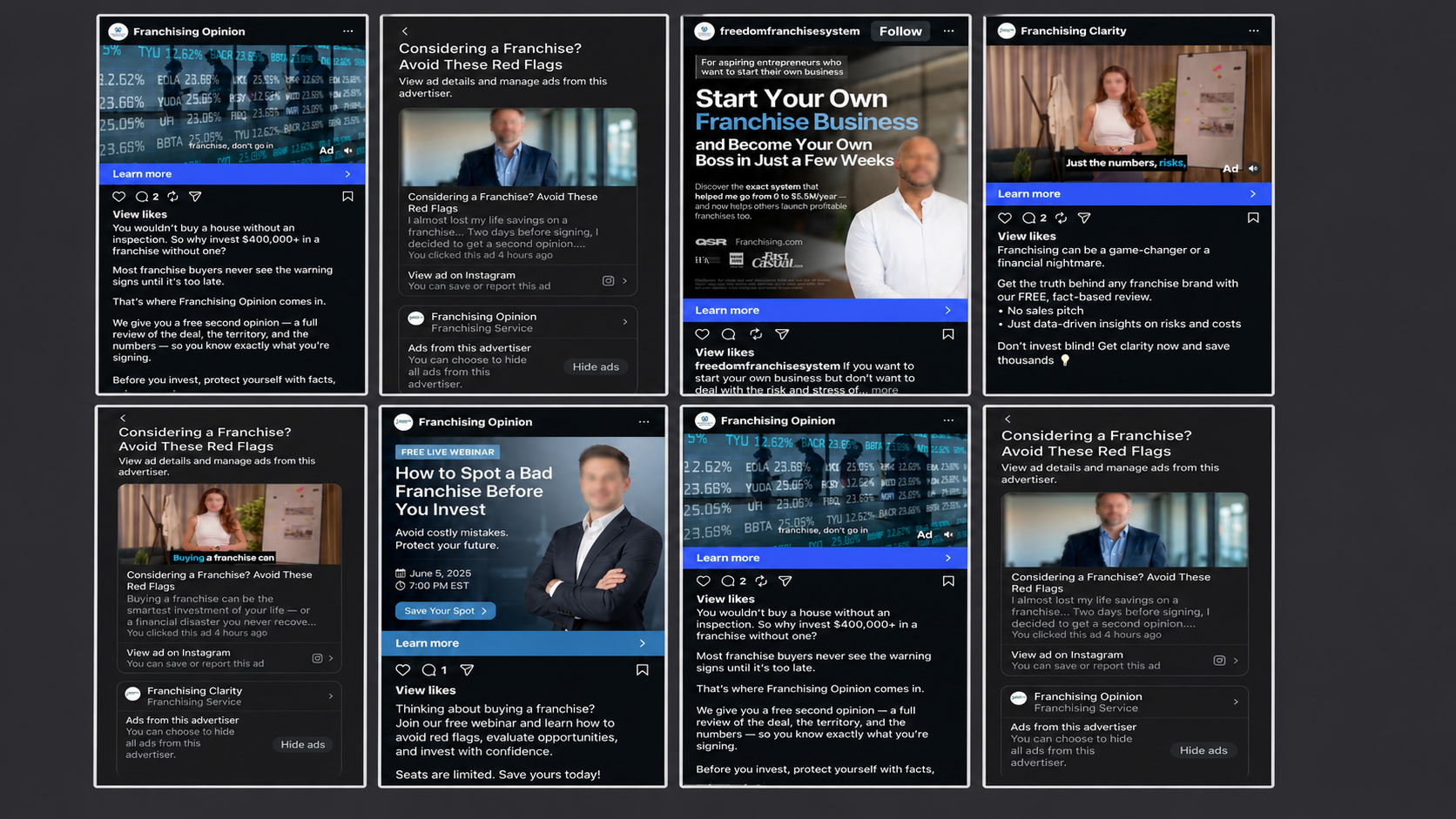
Actual Franchise Broker (Consultant, Mentor, Coach, etc) ads found on Instagram.
Scroll social media long enough and eventually your algorithm will bring the franchise dream right to your screen.
It may show up as an Instagram ad promising that you can “start your own franchise business” and “become your own boss in just a few weeks.” It may appear as a polished video warning that buying a franchise can be “the smartest investment of your life” or “a financial disaster you never recover from.” It may offer a “free second opinion,” a “fact-based review,” a list of “high performing franchises,” or a guide to “low-cost franchises that make $1 million+.”
The pitch changes. The funnel stays familiar.
Before a buyer ever sees the Franchise Disclosure Document, before they read Item 19, before they understand Item 20 closures, before they ask how the broker gets paid, they are often pulled into a carefully designed emotional sequence. First comes the dream. Then comes the fear. Then comes the free guide, free consultation, free webinar, free review, or free second opinion.
And somewhere in that process, a prospective franchise buyer may begin trusting the funnel before they understand the incentives behind it.
That is the franchise sales funnel.
The New Franchise Sales Pitch Does Not Always Look Like a Sales Pitch
Older franchise marketing was easier to recognize. It usually sounded something like this: own your own business, follow a proven system, build wealth, be your own boss, and enjoy the support of a national brand. That pitch still exists. One ad reviewed for this report promoted a “proven, repeatable framework” that makes business ownership “faster, safer, and simpler,” while telling viewers they could start their own franchise business and become their own boss in just a few weeks.
But a newer version of the franchise funnel has emerged. It does not always lead with the dream. Sometimes it leads with the warning.
“Considering a franchise? Avoid these red flags.”
“I almost lost my life savings on a franchise.”
“Buying a franchise can be the smartest investment of your life, or a financial disaster you never recover from.”
This is franchise lead-generation messaging wearing the clothing of consumer protection.
That does not automatically make it improper. Many franchise consultants and brokers may genuinely believe they are helping buyers avoid bad decisions. But prospective franchisees need to understand what they are looking at. A landing page that says “free second opinion” may still be part of a broker funnel. A “fact-based review” may still result in brand recommendations from systems that compensate referral sources. A “no sales pitch” ad may still lead to a sales process.
The sales pitch has evolved.
Now it may begin by warning you about the sales pitch.
The Dream: Freedom, Speed, Control, and the “Proven System”
The emotional appeal is not subtle. The ads and lead magnets reviewed for this report repeatedly lean into the same core desires:
Freedom.
Control.
Escape from a job.
Business ownership without starting from scratch.
A proven roadmap.
Reduced risk.
Financial upside.
Speed.
One Franchise Empire guide obtained through an opt-in funnel is titled “42 High Performing Franchises” and promises to help readers “Reduce Your Risk So That You Can Buy A Money-making Franchise With Confidence & Protect Your Assets.”
Another Franchise Empire guide is titled “5 Low-Cost Franchises That Make $1 Million+” and says it is backed by a “Zero To Profitable Franchise System” used to “Find, Vet, and Launch A Proven Money Making Franchise Like Clock Work.”
That language matters.
It does not merely say, “Here are franchise opportunities that may be worth researching.” It frames the buyer’s journey around confidence, reduced risk, money-making potential, and a system for finding and launching a proven franchise. For a person who is burned out, underpaid, recently laid off, looking for a second act, or afraid they are running out of time to build wealth, that kind of message is powerful.
It also creates a dangerous mental shortcut: if the system is proven, the buyer may assume the risk has already been filtered out.
It has not.
The Fear: Red Flags, Life Savings, and Financial Disaster
The other side of the funnel is fear.
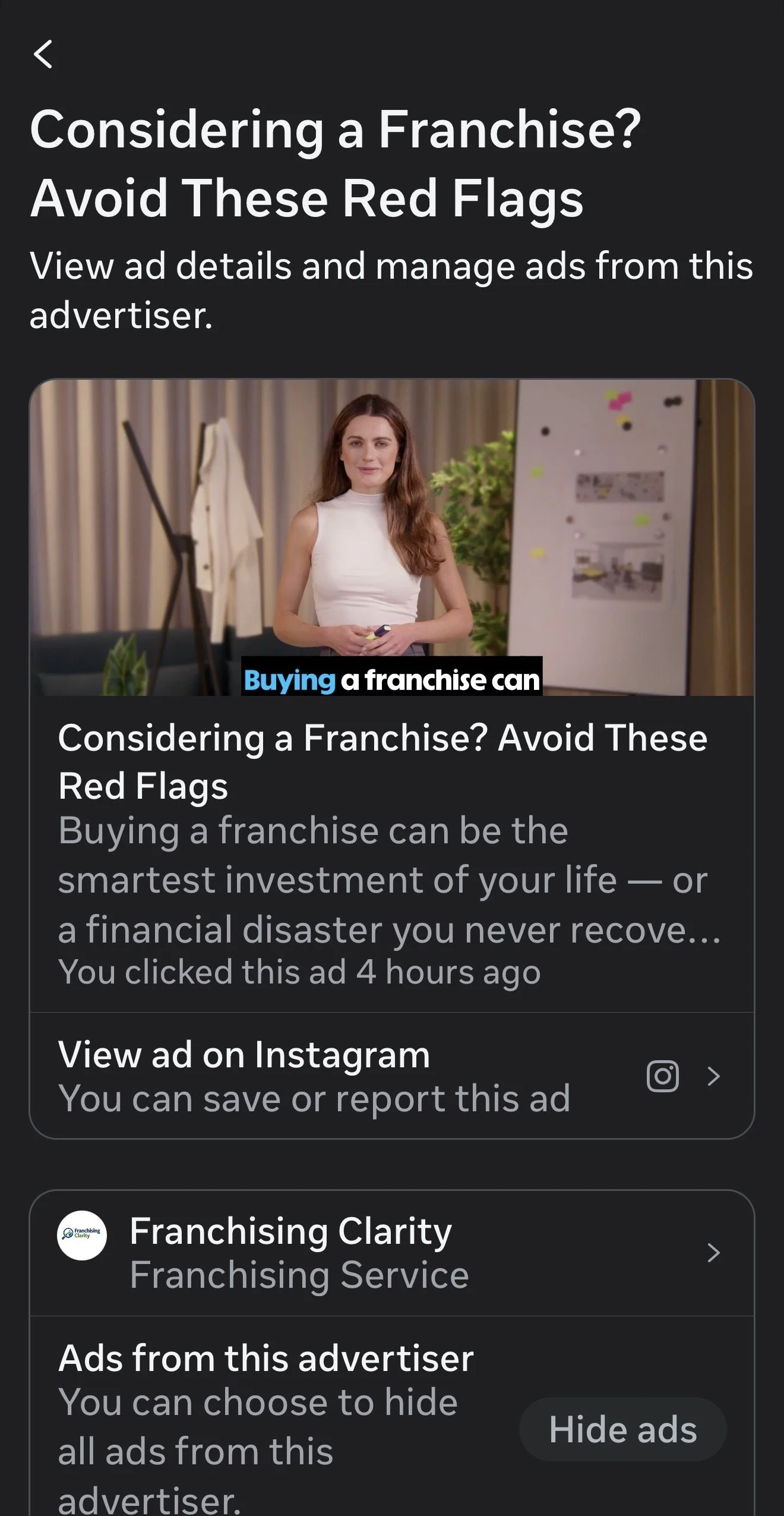
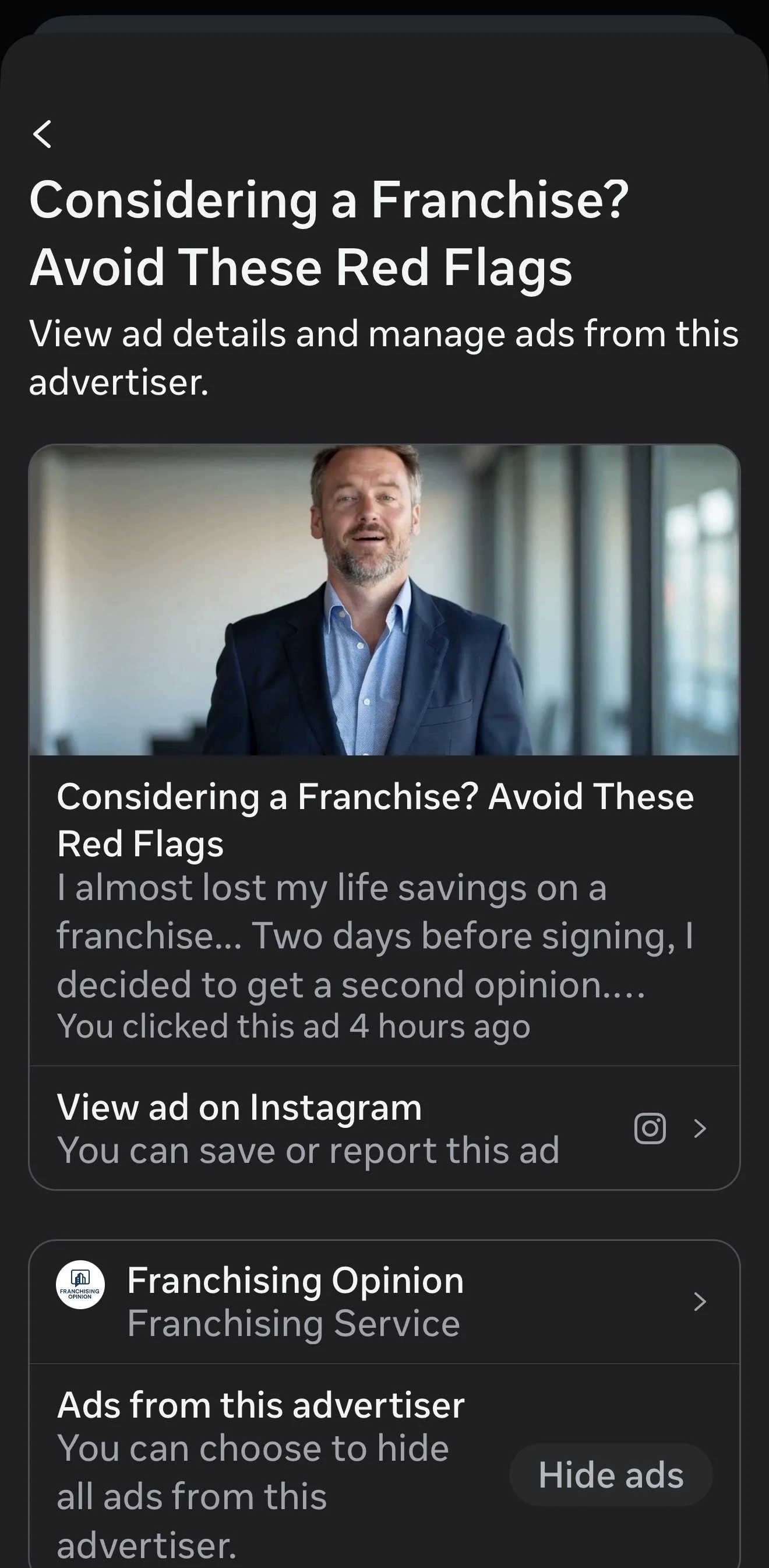
Fear-based marketing can be effective because it positions the advertiser as the rescuer. The buyer is not just being offered an opportunity. They are being warned about danger and invited to seek protection. That is why phrases like “avoid these red flags,” “don’t invest blind,” “second opinion,” and “financial disaster” are so effective. They do not feel like sales language. They feel like due diligence language.
But buyers should slow down and ask a critical question:
Who is providing the second opinion, and how are they compensated if I buy?
That question does not make the source bad. It makes the buyer informed.
The “Free” Layer: Guides, Reviews, Consultations, and Webinars
The funnel often moves from social ad to landing page to lead magnet. The buyer is offered something free:
A list of franchises.
A video breakdown.
A consultation.
A second opinion.
A webinar.
A “fact-based” review.
A quiz.
A customized list of opportunities.
I get it. I use the same thing in a popup giving away a free broker playbook in exchange for an email address right here on this website. The word “free” can make the process feel low-pressure. But in franchise lead generation, free often means the buyer is becoming the lead. And fortunately for me here, I’m not selling anyone a 6-figure franchise.
The “42 High Performing Franchises” guide invites readers to book a free consultation to discuss goals, interests, and availability of “promising franchises” in their area. It describes the consultation as a step toward realizing business aspirations and says the buyer’s “franchise future is calling.”
That is not simply education. That is funnel movement. Again, that does not automatically make it improper. But buyers should understand the sequence:
Ad → Landing Page → Lead Magnet → Consultation → Brand Matching → Franchise Introduction → Possible Sale.
By the time the FDD arrives, the buyer may already be emotionally invested in a concept, a consultant, a story, or a vision of who they could become.
That is why the funnel matters.
The Fine Print Says the Quiet Part Carefully
Here is where the contrast becomes important. The marketing language is often confident, aspirational, and emotionally charged. The disclaimers are more cautious.
The “42 High Performing Franchises” guide states that its data is sourced from the latest available FDD for each franchise, advises readers to consult Item 19 of the most recent FDD, warns that information may have been updated, and advises buyers to confirm fees, investment requirements, and specific franchise offers directly with the franchisor.
The same disclosure section says the content is informational, should not be interpreted as an offer to sell or invitation to purchase a franchise, and that only a proper Franchise Disclosure Document can officially propose a franchise.
The “5 Low-Cost Franchises That Make $1 Million+” guide contains similar cautionary language, including that buyers should examine the FDD and seek legal and financial advice before deciding on a franchise investment.
That is the tension.
The headline sells confidence.
The disclaimer tells you to verify.
The ad sells speed.
The disclaimer tells you to slow down.
The funnel sells the dream.
The FDD contains the obligations.
A buyer who only absorbs the marketing may walk away believing the opportunity has been pre-vetted, pre-filtered, and de-risked. A buyer who reads the fine print should understand something different: the responsibility to verify remains with the buyer.
The “High Performing” Problem
One of the most important patterns in these materials is the repeated use of performance framing.
The guides reviewed for this report highlight franchises using phrases such as:
High performing.
Top performers.
Strong margins.
Average revenue.
Scalability.
Recurring revenue.
Low overhead.
Proven demand.
Recession-resistant.
Million-dollar sales.
The “42 High Performing Franchises” guide says the list was built from “thousands of hours” of research and that every franchise included had been vetted for financial performance, leadership and support, and proven demand.
That sounds reassuring.
But prospective franchisees need to understand what performance data does and does not tell them.
Revenue is not profit.
Top performers are not typical performers.
Corporate margins are not necessarily franchisee margins.
Adjusted profit is not always owner take-home income.
Average sales can hide wide differences between locations.
Mature locations may not reflect new franchisee ramp-up.
Multi-territory results may not apply to a single-territory buyer.
Gross sales do not show debt service, payroll, rent, insurance, vehicles, royalties, marketing fees, vendor markups, or working capital strain.
The problem is not that performance information exists. Buyers need performance information. The problem is when performance language is presented in a way that encourages emotional confidence before analytical review.
Examples That Deserve a Slower Look
This report is not a full review of every franchise listed in the guides. That would require a separate FDD-by-FDD analysis. But several examples illustrate why buyers should slow down when a lead magnet highlights big numbers, rapid growth, or attractive industry narratives.
Rolling Suds
The “42 High Performing Franchises” guide positions Rolling Suds as a breakout success story, highlighting rapid expansion to more than 170 territories in just a few years, corporate-level margins in the 33%–37% range, and a model built on national accounts, centralized call center support, and proprietary soft-wash drone technology. It emphasizes that the business requires no specialized licensing or skilled labor and frames the concept as highly scalable with strong profit potential.
That narrative will sound familiar to anyone who has reviewed franchise marketing materials over the past several years. It checks every box: speed, simplicity, scalability, and strong margins.
However, as outlined in prior Franchise Reality Check reporting, Rolling Suds is also a clear example of why those claims should be viewed as a starting point and not a conclusion.
One of the most notable elements in the brand’s growth story is the pace at which territories have been awarded. Rapid expansion can signal strong demand, but it also introduces a different set of risks that are not reflected in marketing language. The ability of a franchisor to sell territories does not automatically translate into the ability to support those franchisees at scale. As systems grow quickly, infrastructure: training, field support, lead generation, and operational consistency, must keep pace. That is not guaranteed.
In reviewing the brand’s disclosure history, there have also been evolutions in Item 7 cost assumptions, particularly around core operational components such as equipment and vehicle-related expenses. Changes in estimated startup costs are not uncommon in franchising, but they are important. They can reflect shifts in how the business is actually being operated in the field versus how it was initially presented to prospective buyers.
The business model itself also deserves a closer look. Power washing and exterior cleaning are inherently local, labor-dependent services. While national accounts and centralized call centers may be positioned as a competitive advantage, the day-to-day success of the business still depends on local execution; hiring and retaining crews, managing equipment, handling scheduling, and generating consistent demand within a defined territory. Seasonality, weather, and regional market saturation can all materially impact performance.
The margin discussion is another area where buyers should slow down. Corporate margin figures (particularly those tied to company-owned operations) do not necessarily reflect what a franchisee will experience after royalties, local marketing spend, labor, fuel, maintenance, insurance, and debt service are accounted for. The gap between corporate performance and franchisee reality is one of the most common misunderstandings in franchise investing.
None of these factors make Rolling Suds inherently problematic. What they do illustrate is how easily a high-growth, high-margin narrative can overshadow the operational complexity behind the model. The more attractive the headline, the more important it is to examine what sits underneath it.
For prospective franchisees, this means going beyond the marketing summary and asking more specific questions. How are newer franchisees performing compared to early entrants? What percentage of territories are actively operating versus awarded? How are leads actually generated and distributed? What does a typical owner’s day look like, and how many employees are required to sustain operations? How long does it take to reach breakeven, and how much working capital is needed along the way?
The answers to those questions are not found in a “high performing franchise” list. They are found in the FDD, in franchisee validation, and in a careful review of how the model functions outside of its best-case presentation.
And that distinction is exactly why this type of opportunity belongs in a deeper due diligence conversation, not a headline.
City Wide Facility Solutions
The same guide describes City Wide Facility Solutions as a management-based commercial services franchise coordinating more than 20 building maintenance services. It cites average 2024 gross sales of $8.9 million and top performers exceeding $50 million.
Those numbers are attention-grabbing. They are also gross sales numbers.
A buyer should ask: What are the actual margins? How much of the revenue passes through to vendors or subcontractors? What working capital is required to manage large accounts? What does owner compensation look like at different revenue levels? How long does it take to reach scale? What happens if major accounts are lost?
Big revenue can still be a thin-margin business.
QC Kinetix
QC Kinetix appears in the “42 High Performing Franchises” guide as a regenerative medicine and pain relief franchise with average annual revenue reportedly ranging from $1.5 million to $3 million and top performers exceeding $5 million.
Healthcare-adjacent franchise concepts deserve a higher level of diligence because the buyer is not just evaluating marketing, demand, and unit economics. They are also evaluating medical oversight, regulatory risk, staffing, patient acquisition, treatment claims, consumer financing, local competition, and the ethical boundaries of high-ticket healthcare marketing.
A franchise buyer should not treat a medical-adjacent concept like a simple “business in a box.”
Cabinet IQ
Cabinet IQ is described as a technology-driven kitchen and bath remodeling franchise with 69 territories awarded, 56 open locations, proprietary AI-powered 3D design tools, a corporate call center, minimal employees, no inventory, mature locations reporting average annual sales up to $3.1 million, and adjusted profits of $347,000 to $497,000 reflecting 15% to 25% margins.
That kind of presentation combines several popular franchise buzzwords: technology, AI, no inventory, subcontractors, high margins, call center, and scalability.
A buyer should ask: What does “adjusted profit” exclude? Are the results based on mature locations only? How many locations are included? How much owner labor is assumed? How reliable are subcontractors? What is the cost and quality of booked appointments? What happens when lead costs rise?
Technology can improve a business model. It does not eliminate execution risk.
Superior Fence & Rail
The “5 Low-Cost Franchises That Make $1 Million+” guide says Superior Fence and Rail’s bottom third of franchisees averaged $1.1 million in sales and that the average of all 30 franchisees was $2.8 million in sales, with only two of those franchisees owning more than one territory.
That is a powerful framing technique. When a buyer sees “bottom third” and “$1.1 million,” the message is clear: even the lower performers generate seven-figure sales.
But again, sales are not profit. In fencing and other home improvement categories, buyers must evaluate material costs, labor availability, subcontractor quality, seasonality, weather, lead generation, warranty exposure, receivables, and the amount of working capital needed to support growth.
A million dollars in sales is not the same thing as a million-dollar business for the owner.
The Broker Incentive Question Buyers Should Ask Earlier
Many franchise buyers do not fully understand how franchise brokers, consultants, referral networks, and lead-generation funnels may be compensated. That lack of understanding can be dangerous.
A buyer may believe they are receiving neutral guidance when they are actually being introduced to a filtered set of franchise brands that participate in a referral network or broker compensation arrangement. That does not mean the recommendation is automatically bad. It does mean the buyer should know the incentive structure.
Some of the pages and ads reviewed for this report use consumer-protection language: “avoid red flags,” “free second opinion,” “no sales pitch,” “fact-based review,” and “clarity.” Public search results for Franchising Clarity describe the site as offering a “completely free second opinion” and state that “Franchise reps sell opportunities” while the service helps buyers avoid risks.
Separately, public search results identify Ryan Perry as a FranChoice consultant, and a public NASAA comment attributed to Ryan Perry states that he is a California resident and franchise consultant with FranChoice.
This report is not asserting that any specific website, ad, or consultant failed to disclose required information. The point is broader: when a funnel presents itself as a protective second opinion, buyers should still ask how the business makes money.
Here are the questions every buyer should ask:
Are you paid if I buy a franchise?
Who pays you?
Do all franchisors pay the same referral fee?
Which brands are in your network?
Which brands are not in your network?
Will you recommend brands that do not compensate you?
Are you acting as a broker, consultant, coach, advertiser, lead generator, or referral source?
Are you registered where registration is required?
Do you have any ownership, referral, advertising, or financial relationship with the brands you recommend?
Can you put that in writing?
The buyer should ask those questions before sharing financial information, before taking a brand introduction, and definitely before relying on a “free” review.
“No Sales Pitch” Can Still Be a Sales Strategy
One of the most fascinating elements in these ads is the way some funnels distance themselves from franchise sales language while still moving the buyer toward franchise sales activity.
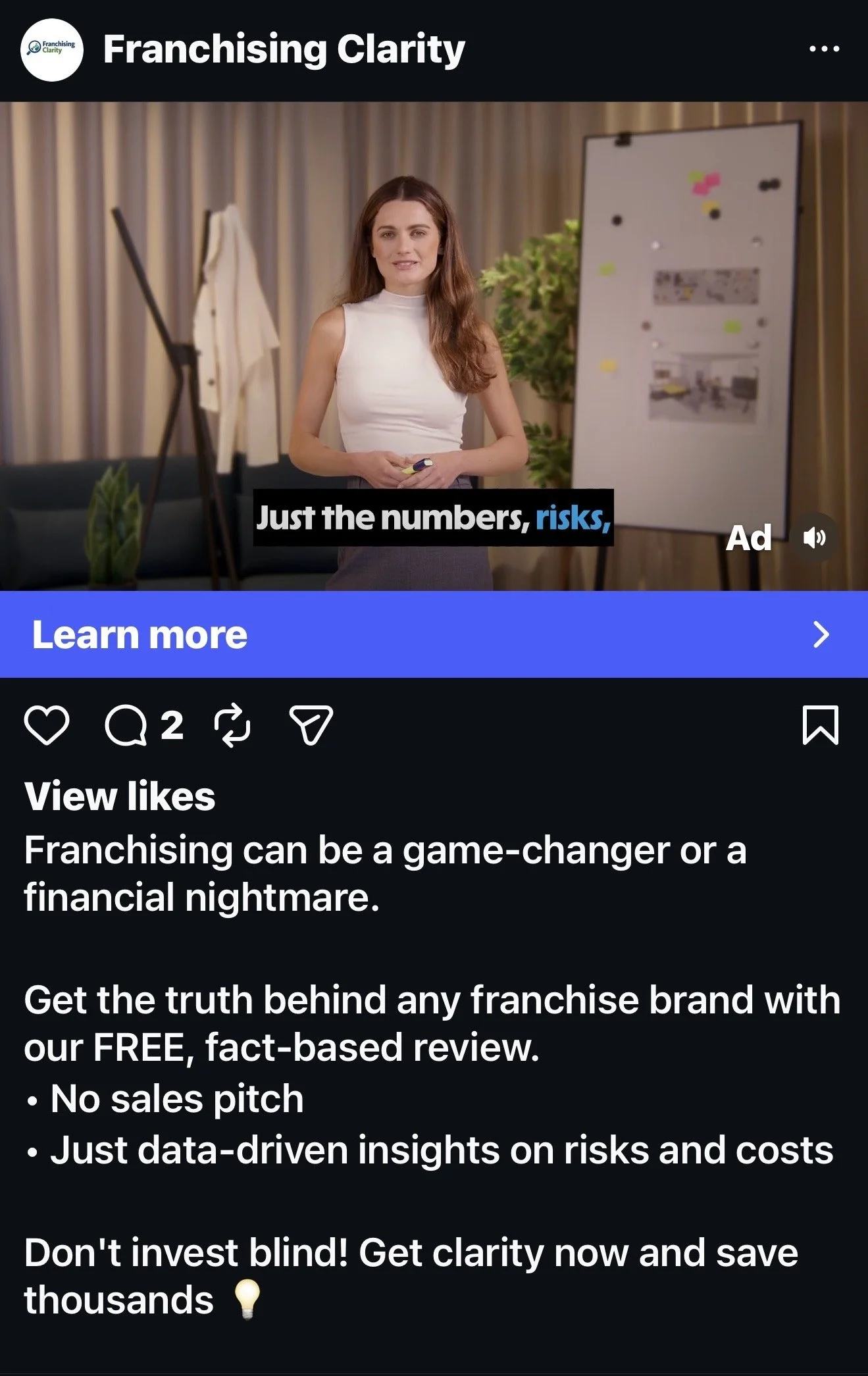
“No sales pitch” and “Just data-driven insights on risks and costs”
“No sales pitch” is an effective phrase because it lowers resistance. It tells the buyer: you are safe here. You are not being sold. You are being educated.
But a buyer should pay attention to what happens next.
Does the site collect your contact information?
Does it invite you to book a call?
Does it ask about your budget?
Does it ask about your desired investment level?
Does it introduce you to franchise brands?
Does it recommend opportunities?
Does it earn compensation if you buy?
If the answer to those questions is yes, then the buyer is not merely consuming education. They are entering a commercial process.
That may be acceptable. It may even be helpful. But it should be transparent.
The Funnel Before the FDD
The most important document in a franchise sale is not the Instagram ad. It is not the landing page. It is not the webinar. It is not the free guide.
It is the Franchise Disclosure Document.
But by the time the FDD arrives, the buyer may already have absorbed weeks of messaging about freedom, lifestyle, scalability, semi-passive ownership, high-performing brands, proven systems, low risk, and financial upside. That emotional priming matters.
If the buyer has already imagined quitting their job, replacing their income, building a family legacy, or becoming the owner of a seven-figure business, they may read the FDD differently. Instead of looking for reasons to say no, they may start looking for reasons to keep believing.
That is how a funnel can shape due diligence before due diligence begins.
When the Funnel Meets Reality: The Dirty Dough Case Study
Every franchise funnel promises some version of the same outcome: a faster path to business ownership, a proven system, and a realistic shot at financial independence. The language may vary, but the underlying message is consistent. With the right brand and the right guidance, the path to ownership can be clearer, safer, and more predictable than starting from scratch.
But that narrative assumes something critical, that the system behind the opportunity is as stable and scalable as the marketing suggests.
The Dirty Dough franchise offers a useful case study in what can happen when that assumption is tested.
Dirty Dough, a cookie franchise that gained national visibility during the so-called “Utah Cookie Wars,” experienced rapid expansion fueled by viral attention, aggressive growth, and strong franchise sales activity. At its peak, the brand reportedly sold hundreds of franchise agreements in a relatively short period of time, driven in part by high demand and a compelling growth narrative.
According to publicly circulated analysis, the system expanded from a few dozen agreements to several hundred signed franchisees, while only a portion of those locations ultimately opened and became operational. Claims from independent reporting suggest that many franchisees who signed agreements did not reach the opening stage, raising broader questions about execution, support capacity, and the realities of scaling a franchise system at that pace.
At the same time, the company has reportedly faced financial and legal challenges, including lawsuits tied to outstanding obligations. While the full scope and outcome of those matters continue to evolve, they highlight a broader issue that prospective franchisees often overlook: rapid franchise sales do not necessarily reflect operational strength.
This distinction matters.
Franchise buyers are frequently presented with growth metrics that emphasize demand; territories sold, agreements signed, system expansion, and brand visibility. Those figures can be compelling, especially when paired with marketing language centered on scalability, momentum, and early-stage opportunity. However, those same metrics can obscure more important questions about whether the franchisor has the infrastructure, capital, and operational maturity required to support that growth.
In other words, selling franchises and supporting franchisees are not the same thing.
This is where the Dirty Dough case becomes particularly relevant to the broader conversation around franchise marketing funnels. It illustrates how quickly a compelling narrative can take hold and how difficult it can be for prospective buyers to separate momentum from stability when they are evaluating an opportunity through a combination of ads, webinars, and curated information.
The relevance does not end there.
What makes this case even more instructive is what can happen after a high-profile franchise system encounters challenges. Individuals associated with those systems may re-enter the market under new branding, often positioned as franchise mentors, consultants, or educators. The messaging evolves to focus on guidance, experience, and helping others avoid the mistakes that led to prior outcomes.
This type of repositioning is not inherently problematic. Experience, even hard-earned experience, can be valuable. However, it introduces another layer of due diligence that prospective franchise buyers must navigate. When evaluating a consultant, advisor, or “franchise mentor,” buyers should not only consider what is being offered, but also the track record behind that expertise.
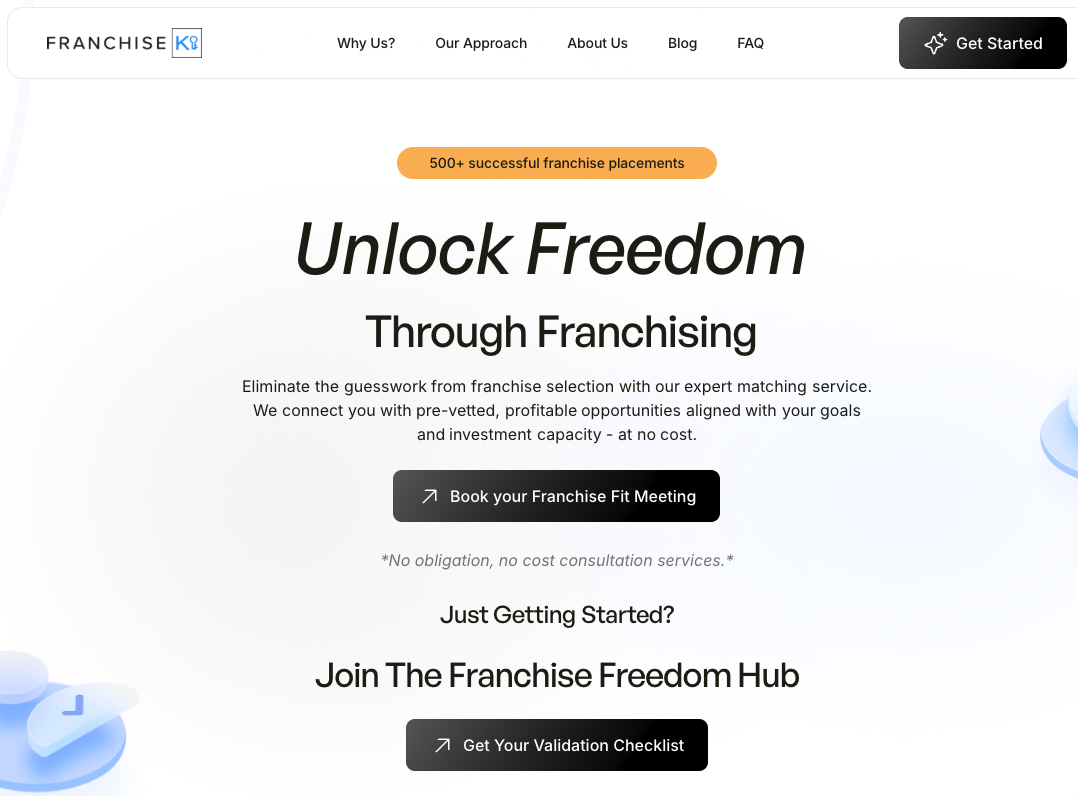
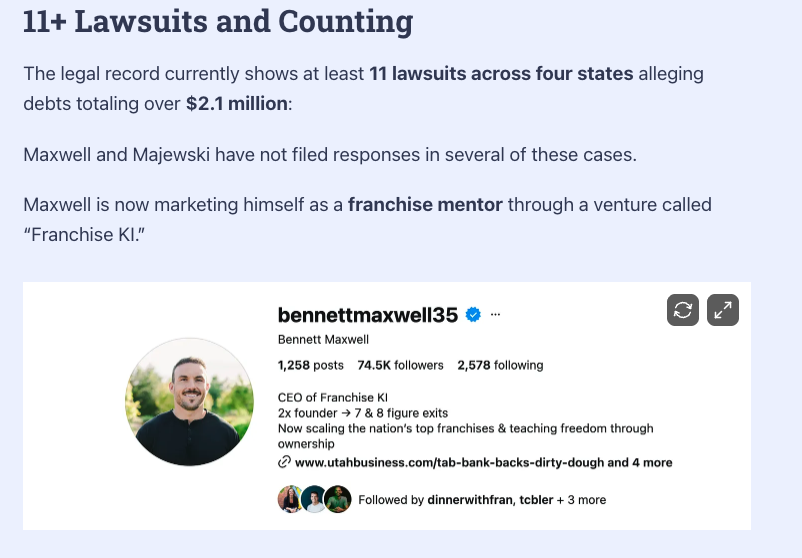
Publicly available information tied to this case indicates that an individual connected to the Dirty Dough system (former Founder and CEO Bennett Maxwell) have since launched new ventures in the franchise advisory space, positioning themselves as guides for aspiring business owners. That shift, from operator to advisor, is not unusual in franchising, but it reinforces an important point: titles such as “mentor,” “consultant,” or “expert” are not regulated designations. They are marketing positions.
For prospective franchise buyers, this creates a responsibility to look beyond the title and examine the underlying experience. What systems has this individual been involved in? What were the outcomes? How many units opened versus how many were sold? What challenges arose, and how were they addressed? These are not accusatory questions. They are foundational due diligence questions.
The broader takeaway from this case is not that every fast-growing franchise is at risk of failure or that every consultant lacks credibility. Rather, it is that the franchise funnel is designed to emphasize possibility, while the risks often require independent effort to uncover.
Marketing materials, lead magnets, and social media ads are highly effective at presenting what is achievable. They highlight success stories, top-performing locations, and scalable models. What they do not typically show is the full distribution of outcomes across the system, the percentage of franchisees who never open, the time required to reach profitability, or the capital needed to sustain operations through the early stages of ownership.
That information is not hidden. It simply exists elsewhere.
It is found in Item 20 of the Franchise Disclosure Document, in litigation history, in franchisee validation calls, and in the unfiltered experiences of current and former operators. It requires effort, context, and, often, a willingness to challenge the narrative that initially drew the buyer into the funnel.
The Dirty Dough case is a reminder of what can happen when growth outpaces infrastructure and when buyers rely too heavily on momentum as a proxy for stability. It underscores the importance of separating marketing from operations and of understanding that a compelling story is not the same thing as a sustainable business model.
For buyers navigating today’s franchise landscape, the lesson is straightforward. The funnel is designed to guide you toward opportunity. It is not designed to complete your due diligence for you.
That responsibility remains with the buyer. And the earlier that responsibility is taken seriously, the better the outcome is likely to be.
What Buyers Should Do Instead
A serious franchise buyer should reverse the funnel. Do not start with the dream. Start with the documents.
Before relying on any ad, guide, consultant, broker, webinar, or franchise “match,” buyers should review:
Item 1: Who is the franchisor and what is its history?
Item 2: Who are the executives and what is their background?
Item 3: What litigation exists?
Item 7: What is the estimated initial investment?
Item 8: What required vendors, rebates, markups, or purchasing restrictions exist?
Item 11: What support is actually required and provided?
Item 19: What financial performance representation is being made, and what is excluded?
Item 20: How many units opened, closed, transferred, reacquired, or failed to open?
Franchise Agreement: What obligations survive after signing?
Buyers should also speak with current and former franchisees, not just the names handed over by the franchisor. Ask about owner hours, profitability, debt, local marketing costs, staffing, vendor issues, support, ramp-up time, and whether they would make the same decision again.
And when reviewing performance claims, buyers should ask one question over and over:
What does this number mean for the owner after all costs, debt, fees, labor, taxes, and required reinvestment?
The Real Red Flag Is Not Always the Franchise
Sometimes the red flag is not the franchise itself. Sometimes the red flag is the way the opportunity is framed.
A franchise can be legitimate and still be marketed with overly emotional language. A broker can be experienced and still have financial incentives. A lead magnet can contain FDD-sourced information and still present that information in a way that emphasizes upside over risk. A “free second opinion” can be useful and still be part of a monetized funnel.
That is why buyers should not ask only, “Is this franchise good?”
They should also ask:
Who is guiding me toward it?
What do they know?
What do they get paid?
What information am I not seeing?
What assumptions am I making because of the ad?
What would make me walk away?
That final question may be the most important one.
Reality Check
Meta ads are not the due diligence process. A free PDF is not an FDD review. A “high performing franchise” list is not proof that a buyer will make money. A “free second opinion” is not automatically independent.
And a “proven system” does not eliminate the risk of debt, thin margins, weak territories, poor support, labor problems, closures, litigation, vendor markups, or personal guarantees.
The franchise funnel is designed to move buyers from curiosity to trust to action. That does not mean every funnel is deceptive. It means buyers need to understand the machine before they become part of it. Because by the time you finally receive the FDD, the dream may already be doing the reading for you.
The information provided in this article is for educational purposes and general public-interest reporting. It does not offer legal, financial, or investment advice. Franchise purchasers should consult qualified professionals before making decisions. Franchise Reality Check™ analyzes publicly available documents, including Franchise Disclosure Documents (FDDs), state regulatory filings, and court records. Under Oklahoma Statutes and applicable federal law, analysis of publicly filed franchise documents, commentary on matters of public concern, and reporting on franchise industry practices are protected forms of speech.
