
California Pizza Kitchen
When a Legacy Brand Becomes a Platform And Franchisees Become the Product
California Pizza Kitchen (CPK) is one of the most recognizable casual dining brands in America. For many consumers, it still conjures images of upscale mall dining, creative pizzas, and the famous BBQ Chicken Pizza that helped define “California cuisine” in the 1990s.
But today’s CPK is no longer primarily a restaurant company. It is a brand platform.
And like most brand platforms in franchising, the value proposition is no longer centered on unit-level profitability. It is centered on brand monetization across multiple channels, with franchisees playing a very specific and carefully constrained role inside that ecosystem.
Let’s break down what the 2025 Franchise Disclosure Document (FDD) actually reveals about that model, and why franchisees need to read this one very carefully.
The Corporate Context: Post-Bankruptcy + Capital Repositioning
CPK filed for Chapter 11 bankruptcy in July 2020 and emerged in 2021 after shedding significant debt and restructuring under creditor control. From that point through most of 2025, CPK remained effectively under lender ownership and financial oversight, not under long-term strategic or founder ownership.
Then, in December 2025, well after the release of the 2025 FDD, CPK formally announced a sale to an investor group led by Consortium Brand Partners, with partners including Eldridge Industries, Aurify Brands, and Convive Brands, signaling a transition into private-equity–aligned ownership.
Why this timing matters:
The 2025 FDD was issued before that ownership change, which means franchisees reviewing that FDD are evaluating:
A brand still under post-bankruptcy creditor control
Without disclosures reflecting the incentives, strategies, or risk profile of the new ownership group
And without insight into how that ownership transition may reshape franchising, fees, support, or expansion priorities going forward
This is not just a technicality, it means franchisees are buying into a system that is mid-transition, with major strategic changes likely to follow.
An Admission: The Franchisor’s Own Financial Risk Warning
In the “Special Risks” section, CPK makes an unusually blunt disclosure:
The franchisor’s financial condition calls into question the franchisor’s financial ability to provide services and support to you.
This is not boilerplate. This is the franchisor itself warning prospective franchisees that:
Support may be constrained
Resources may be limited
And the system is not financially robust in the way a franchise buyer might assume
When a franchisor flags its own financial stability as a risk, franchisees should treat that as a flashing red light, especially when paired with multi-million-dollar buildout requirements.
The Investment Reality: Luxury Capital, No Financial Transparency
Opening a new traditional CPK location requires between $1.5 million and $5.3 million, excluding real estate.
Yet the FDD provides:
No average unit volumes
No profit margins
No EBITDA
No cash flow ranges
No payback periods
No segmentation between traditional, airport, or non-traditional units
In other words, franchisees are being asked to invest at somewhat high capital levels with zero disclosed performance history.
Item 8: The Supply Chain as a Future Profit Center
CPK controls:
Approved suppliers
Distribution channels
Vendor eligibility
Product specifications
And supplier approval processes
They also reserve the right to:
Become a supplier themselves
Use affiliates or buying cooperatives they organize
Negotiate rebates, commissions, or incentives from vendors
And retain those benefits without sharing them with franchisees
Even though they currently report no such supplier revenue, the structure is already in place. This is the modern franchising model. Not “sell franchises,” but monetize the supply chain.
Once embedded, this model:
Locks franchisees into higher-cost inputs
Removes pricing autonomy
And shifts margin upstream to the franchisor
Franchisees do not just operate restaurants, they become captive purchasers.
Item 12: “Territory” That Doesn’t Actually Protect You
On paper, CPK grants franchisees a Protected Territory. In reality, that territory is riddled with carve-outs.
The franchisor explicitly reserves the right to:
Sell branded food through grocery stores
Operate vending machines
Launch kiosks, carts, and pop-ups
License ghost kitchens
Sell through e-commerce
And operate in airports, campuses, stadiums, casinos, and other non-traditional venues
Even if those are inside your territory. The only thing you truly control is your four walls. Everything else, including how customers access the brand in your market, belongs to corporate.
This is not territorial protection. This is geographic illusion.
The Retail & Vending Machine Strategy: The Quiet Channel Conflict
Grocery Store Sales
CPK-branded pizzas and products are sold in retail grocery stores nationwide.
This creates a fundamental shift in the franchise relationship:
The brand is no longer tied exclusively to restaurants
The consumer relationship moves upstream
And price competition enters your market from inside your own brand
When a customer can buy a CPK pizza in a freezer aisle for $8–$10, it permanently reframes what they expect to pay for that brand. This is not “brand expansion” it is price anchoring against franchisees.
And franchisees receive:
No share of retail revenue
No territory protection
No compensation for brand dilution
No pricing control
Vending Machines & Automated Sales
CPK is now actively deploying pizza vending machines and automated food concepts in high-traffic venues, including airports, like this one at Dallas Love Field.
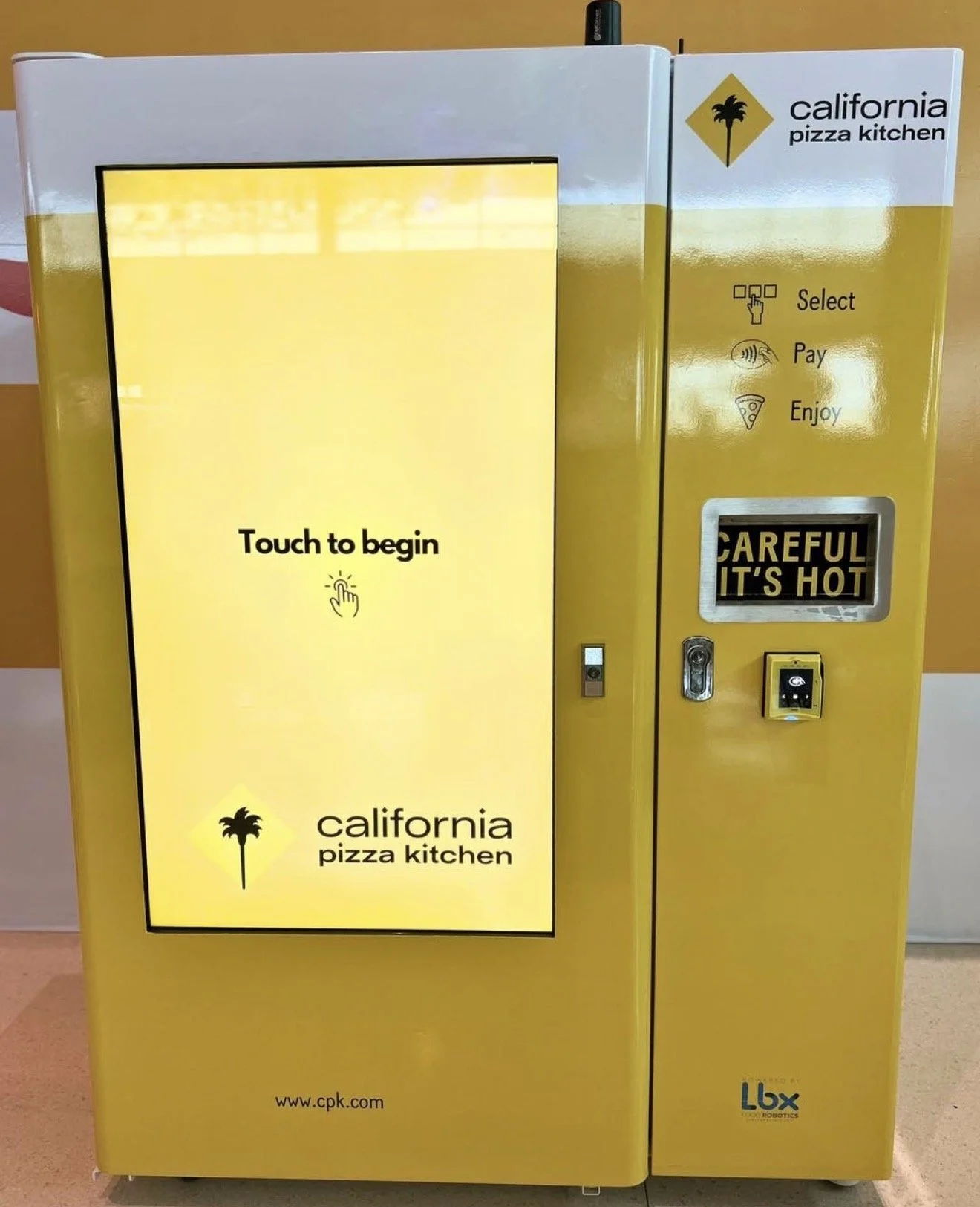
Image courtesy of @texanreport, Instagram, April 1, 2025
This matters for three reasons:
These units operate with lower labor, lower overhead, and centralized control
They compete for the same consumer dollars as franchise restaurants
They appear to be entirely controlled by corporate, not franchisees
So while franchisees absorb:
Labor volatility
Rent inflation
Insurance escalation
Food cost swings
Corporate expands into:
Fully automated, margin-optimized distribution
With no franchisee participation required
In my opinion, this is not innovation for franchisees.
Item 20: The System Is Shrinking, Not Growing
Looking at the outlet data:
Total units declined year over year
Company-operated units declined
Franchised units declined
There were zero franchise transfers for three consecutive years
A healthy franchise system typically shows:
Modest growth
Or at least transfer activity
Or meaningful pipeline development
CPK shows:
Retrenchment
Restructuring
And a system still searching for its post-bankruptcy equilibrium
More telling, the vast majority of franchisees listed are not street retail operators.
They are:
Airport concessionaires
Hospitality operators
Institutional venue partners
That means the “typical” CPK franchisee is not a multi-unit restaurateur building neighborhood restaurants. They are a corporate foodservice operator embedded in travel, leisure, and captive environments.
If you are evaluating CPK as a retail franchise, you are not stepping into the system that CPK is actually optimized for.
Contractual Leverage: Why Exiting Is Financially Dangerous
If your franchise is terminated early, CPK can require you to pay up to 48 periods of future royalties and marketing fees, even after closure.
That creates a structural trap:
Underperforming units cannot simply exit
Walking away triggers massive financial liability
And leverage shifts entirely to corporate
This is not just a contract, it is a containment mechanism.
The Bigger Picture: What CPK Is Really Selling
CPK is not selling a restaurant opportunity.
It is selling:
A brand access license
Within a multi-channel monetization strategy
Where franchisees provide:
Capital
Real estate risk
Labor exposure
Market development
While corporate retains:
Channel control
Brand monetization
Retail expansion
Automation strategy
Supply chain upside
Franchisees are not partners in growth, they are one revenue stream among many.
Who This Franchise Might Still Make Sense For
CPK may still be a rational investment for:
Sophisticated multi-brand operators
Airport and concession specialists
Hospitality groups with existing infrastructure
Operators seeking brand leverage inside captive venues
It is far less suited for:
First-time franchisees
Owner-operators
Street retail-focused restaurateurs
Or anyone expecting territorial exclusivity or long-term brand protection
Final Reality Check
California Pizza Kitchen is not a failing brand, but it is no longer a franchise-first brand. It is a brand platform pursuing:
Retail monetization
Automated distribution
Institutional partnerships
And asset-light growth
All of which reduce franchisee leverage, increase competition from inside the brand, and structurally favor corporate optionality over operator stability.
The question is not:
“Is CPK a recognizable brand?”
The real question is: Does this brand still need franchisees, or just their capital?
Franchise Reality Check™ is an independent, Oklahoma-based publication providing investigative analysis of franchise systems for purposes of public education and transparency. Reports are based on publicly available records, firsthand accounts, and other sources believed to be reliable, and are published in good faith.
All commentary is protected under Article II § 22 of the Oklahoma Constitution, the First Amendment to the United States Constitution, and Oklahoma’s News Media Privilege (12 O.S. § 2506). Statements of opinion, analysis, and interpretation constitute fair comment on matters of public concern.
To the extent factual statements are included, they are either drawn from public records or are substantially true. Nothing herein constitutes legal, financial, or investment advice.
